Search for brightening and anti-aging, and two ingredients always rise to the top: niacinamide and vitamin C. Both are icons of bright, healthy skin. But an old rumor follows this pair around: that you can’t use them together.
Here’s the verdict up front: that rumor is wrong. And in fact, these two aren’t rivals — they’re the best of teammates.
The short answer
Here’s the summary. Niacinamide and vitamin C are ingredients with different approaches. If vitamin C is the “offense” that actively brightens and protects, niacinamide is the “defense” that strengthens the barrier and calms. Their goal — bright, even skin — is similar, but their methods differ. So used together, they complement each other. The “don’t mix” claim is an old misconception, which we’ll address precisely below.
Vitamin C, in 30 seconds
Vitamin C (mainly ascorbic acid) is one of the most-researched ingredients in skincare. It plays what you might call the “offense” role. As a potent antioxidant, it neutralizes free radicals from UV and pollution, directly inhibits melanin production to fade dark spots, and supports collagen production to help with firmness and fine lines. Most people notice skin radiance first, within about 10–14 days, with pigment improvement taking longer.
In a word, it’s an active brightening-and-protecting ingredient.
Niacinamide, in 30 seconds
Niacinamide (vitamin B3) is closer to the “defense.” It helps produce ceramides to strengthen the barrier, calms redness, regulates oil, and refines pores. It brightens too, but differently — by blocking melanin from transferring to the skin’s surface cells. Improvements in oil and texture typically show over 2–4 weeks.
In a word, it’s a strengthening-and-calming foundation ingredient.
More on niacinamide → What Is Niacinamide? The Do-It-All Ingredient Explained (2026)
The key difference: offense vs defense
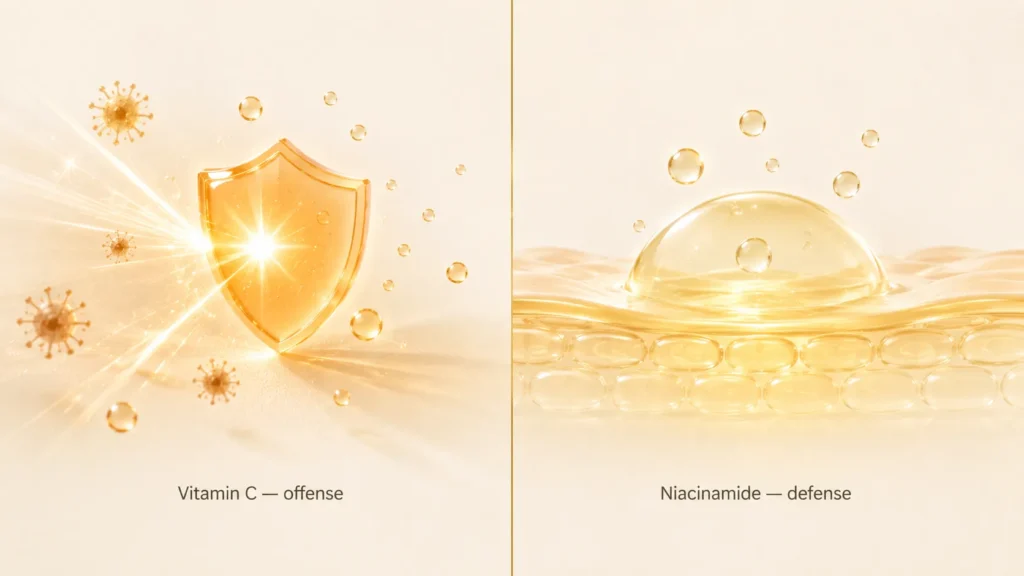
Here’s the summary. The two overlap in evening tone and antioxidant defense, but differ on almost everything else.
Vitamin C is “offense.” It actively brightens, protects against UV and pollution, and stimulates collagen. It’s strong at fighting environmental damage.
Niacinamide is “defense.” It strengthens the barrier, calms, and regulates oil. It’s strong at building up the skin’s foundation.
Their brightening goal overlaps, but the method differs: vitamin C inhibits melanin production, while niacinamide blocks melanin transfer. They act at different stages — so used together, they even create synergy on brightening.
Side by side
| Vitamin C | Niacinamide | |
|---|---|---|
| What it is | Ascorbic acid (antioxidant vitamin) | Vitamin B3 |
| Role | Offense — brighten, protect, collagen | Defense — barrier, calm, oil |
| Brightening method | Inhibits melanin production | Blocks melanin transfer |
| Strengths | Dark spots, antioxidant, firmness | Oil, pores, barrier, redness |
| When results show | Radiance in 10–14 days, pigment longer | Oil & texture in 2–4 weeks |
| Stability | Pure form is delicate (light, air) | Stable |
| Using together | Works — real synergy | Works — real synergy |
The truth about the “don’t mix” myth
Now let’s address that rumor. The story that “niacinamide and vitamin C cancel each other out or turn your skin red” — where did it come from?
The myth traces back to a 1960s experiment. It was a reaction observed when the most unstable form — pure ascorbic acid — was handled under extreme conditions like very high temperatures. The problem is that those conditions have nothing to do with modern skincare.
Today’s vitamin C products are pH-balanced and stabilized. Your bathroom shelf isn’t a 1960s lab. In fact, modern studies consistently show positive results when the two are used together. These days, it’s common to find both in a single product.
So what about the claim that it causes irritation? If redness appears, it’s more often due to using several strong actives at once, or to individual sensitivity, than to this specific pairing.
How to use them together

So how do you use them together? Two ways.
Layer them in the same routine. Apply vitamin C first, let it absorb briefly (30–60 seconds), then layer niacinamide on top.
Split them by time of day. You can also use vitamin C in the morning (antioxidant protection through the day) and niacinamide at night (repair). In the morning, don’t forget sunscreen last.
If you’re new to both, it’s safer to introduce one at a time — give it about two weeks — before adding the other.
Curious about niacinamide’s pairing and concentration? → What Is Niacinamide? The Do-It-All Ingredient Explained (2026)
So which should you choose?
If you’re picking just one, decide by your skin concern.
When vitamin C fits. If dullness, dark spots, environmental protection (antioxidant), or collagen and firmness come first, choose vitamin C.
When niacinamide fits. If oil and pores, a weakened barrier, or redness and sensitivity come first, choose niacinamide.
For sensitive skin, niacinamide is generally gentler and a good starting point.
But remember — you don’t have to pick just one. Used together, you get both offense and defense.
Frequently asked questions
Niacinamide or vitamin C — which is better? It’s a difference in role, not a ranking. For brightening, antioxidant, and collagen, vitamin C; for oil, pores, barrier, and calming, niacinamide.
Can I use them together? Yes. The “don’t mix” myth has been debunked. Used together, they actually complement each other with synergy.
How do I use them together? Apply vitamin C first and let it absorb, then layer niacinamide — or use vitamin C in the morning and niacinamide at night.
Why were they said not to mix? It comes from a 1960s experiment handling an unstable form of vitamin C under extreme conditions. It has nothing to do with modern skincare.
What if I get irritation? It’s more likely from using several actives at once or individual sensitivity than the combination. Introduce one at a time and watch your skin.
Which is better for sensitive skin? Niacinamide is generally gentler and a good starting point.
The bottom line
Niacinamide vs vitamin C isn’t really about who wins. Vitamin C is the offense that brightens and protects; niacinamide is the defense that strengthens and calms. Different approaches, both excellent. Forget the old “don’t mix” myth — used together, these two become the best team for covering nearly every skin concern.