
Look at any skincare ingredients list and niacinamide is almost always there — in serums, toners, creams, even sunscreens. Yet ask people what it actually does, and few can answer precisely.
There’s a good reason for that. Niacinamide doesn’t do one thing — it does several.
The short answer
First, to clear it up: niacinamide is a form of vitamin B3 that does everything from oil control to brightening to barrier strengthening — a true multitasker. It’s also well-backed by research, which is why it’s called a “do-it-all” ingredient. But “do-it-all” can feel vague, so let’s look at exactly what it does, one thing at a time.
What exactly is niacinamide?
Niacinamide (also called nicotinamide) is the active form of vitamin B3. Being water-soluble, it absorbs into skin relatively well, and unlike ingredients that sit on the surface, it’s understood to penetrate into the skin’s layers and work at the cellular level.
For context, it’s different from the similarly named “niacin.” Niacinamide is the gentler, more stable form for skin, and it’s the one used in skincare.
The key: niacinamide does several things
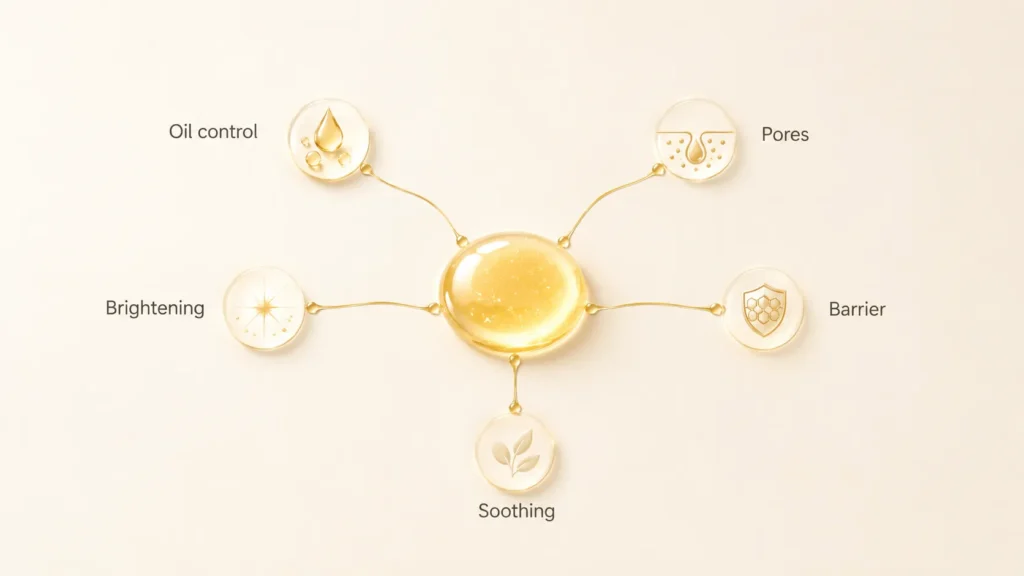
This is why niacinamide is called a multitasker. Specifically, it does the following.
Oil control. It helps reduce excess sebum production, easing shine.
Pores. It’s involved in visibly refining enlarged pores over time.
Brightening (pigment). It’s said to improve dark spots and uneven tone — by blocking the process where melanin transfers to the skin’s surface cells.
Barrier strengthening. It helps produce ceramides to fortify the skin barrier and reduce water loss.
Soothing. It also helps calm redness and irritation.
So rather than one concern, niacinamide works across several — oil, pores, pigment, barrier, and redness.
What the science says
Niacinamide is among the better-researched ingredients in skincare. A few examples:
Oil: Studies have found it meaningfully reduces sebum production at a 2% concentration.
Barrier: It’s reported to strengthen the barrier by boosting ceramide and fatty-acid production.
Brightening: In one clinical trial, 5% niacinamide significantly reduced hyperpigmentation over several weeks.
For balance, though: niacinamide isn’t a “miracle overnight,” either. Changes typically show over several weeks to a couple of months of consistent use, with individual variation. It’s most accurate to see it as a well-backed “solid foundation” ingredient.
On concentration: more isn’t better
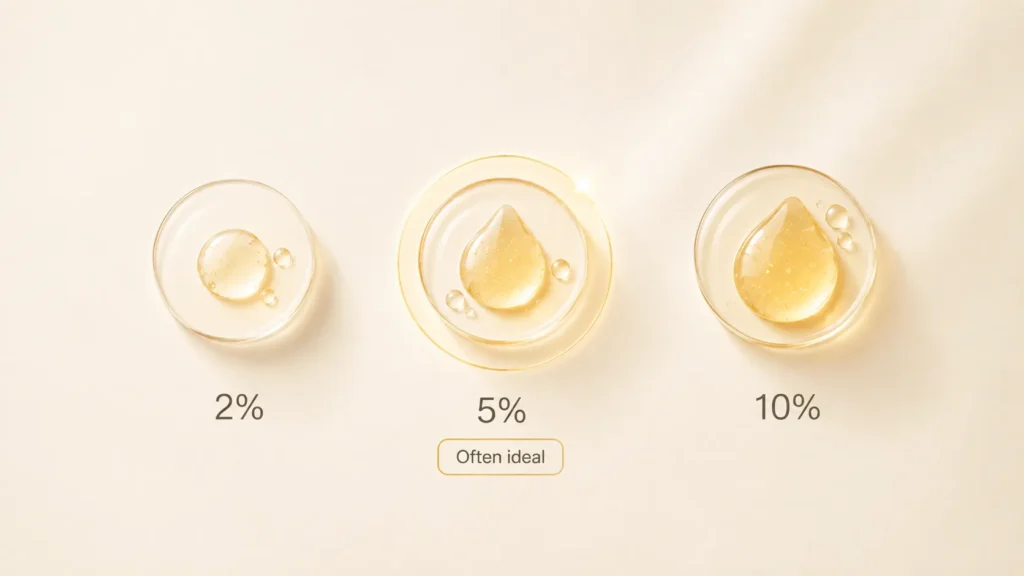
Here’s the part that matters in practice. Products come in various concentrations — 2%, 5%, 10% — and a common misconception is “higher is better.” That’s not the case.
According to research, most benefits appear sufficiently at 2–5%. Around 5% is considered a good balance of efficacy and gentleness.
What about 10%? For some people it may offer faster oil control or pore refinement, but it isn’t necessary, and irritation risk rises — especially when layered with exfoliating acids or retinol. Concentrations above 10% have little independent research behind them, and tend to become more reactive rather than more effective.
The key is this: consistency matters more than concentration. Using a lower concentration daily generally beats using a higher one irregularly. If your skin is sensitive, start at 2–5% and watch how it responds.
Who it’s for, and how to use it
Niacinamide’s big advantage is that it suits almost every skin type and is easy to combine. Being gentle, it’s easy for sensitive skin to try.
Apply it at the serum step after cleansing and toner, then finish with moisturizer. You can use it morning and night.
There’s a common myth about combining it: “niacinamide and vitamin C shouldn’t be used together.” Modern research has debunked this. In fact, used together they can create antioxidant synergy. If you feel irritation, it’s more likely due to the vitamin C’s concentration than the combination itself.
The niacinamide vs vitamin C comparison → [Niacinamide vs Vitamin C — planned]
Curious about soothing and barrier ingredients? → What Is Cica Skincare? Centella Asiatica Explained (2026)
Patch-test any new product on your inner arm first. This article is for information, not medical advice.
Frequently asked questions
What does niacinamide do? It does several things — oil control, pore refining, brightening, barrier strengthening, and soothing. It’s a form of vitamin B3 and a well-backed multitasker.
What concentration is best? Most benefits appear at 2–5%. Higher isn’t better, and 10% can raise irritation risk.
Can I use it every day? Yes, it’s gentle, so generally you can. It works morning and night; if you’re sensitive, start slowly.
Can I use it with vitamin C? Yes. The old “don’t combine them” myth has been debunked. Used together, they can offer antioxidant synergy. Any irritation may be due to the vitamin C’s concentration.
When will I see results? Not immediately. Changes usually show over several weeks to a couple of months of consistent use, with individual variation.
Is it OK for sensitive skin? It’s gentle, so generally yes. Start at a 2–5% concentration and patch-test.
The bottom line
Niacinamide is a “do-it-all foundation” ingredient from vitamin B3 that handles several things at once — oil, pores, brightening, barrier, and soothing — with solid research behind it, suiting almost every skin type and combining easily. Remember two things: higher concentration isn’t better (2–5% is plenty), and consistency matters more than concentration. It may not be flashy, but it’s a great one to keep around for the long run.