For people who want retinol’s benefits but not its irritation, the hottest answer in 2026 is bakuchiol. Known by the nickname “natural retinol,” it’s become a talking point in anti-aging skincare. But that nickname is only half right.
This guide covers everything you need to know about bakuchiol: what it is, what the science says, how it differs from retinol, how to use it, and what to know during pregnancy. Get the big picture here, then follow the links to go deeper.
What is bakuchiol?
Bakuchiol is extracted from the seeds of the babchi plant (Psoralea corylifolia), an ingredient used in Ayurvedic and Chinese medicine for centuries.
The name makes it easy to assume it’s a cousin of retinol, but bakuchiol is not vitamin A at all. Its chemical structure differs, and it doesn’t convert into retinoic acid in the skin. Instead, it works through a different pathway to produce effects similar to retinol’s.
More on what it is and where it comes from → What Is Bakuchiol? The Gentle Retinol Alternative Explained (2026)
The key: a gentle alternative, but not a “retinoid”
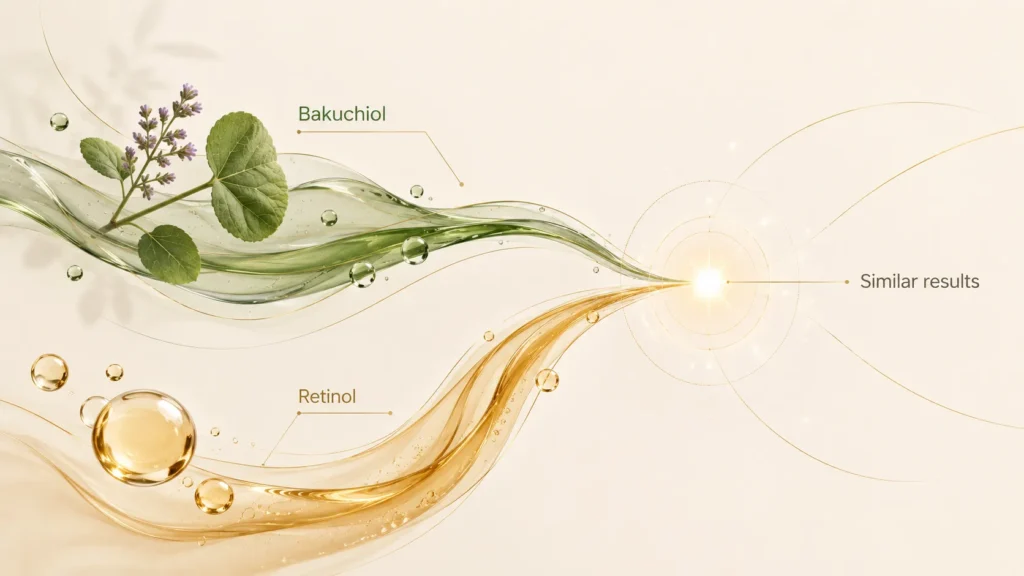
This is the most important point in understanding bakuchiol. The “natural retinol” nickname makes it easy to assume it’s a natural version of retinol, but bakuchiol is not a retinoid.
It’s a chemically different ingredient from retinol, and it works through a different pathway. But the result is similar to retinol’s — supporting collagen production and improving fine lines, texture, and tone.
In other words, the “destination” is similar, but the “route” is different. Understand this, and you can see bakuchiol accurately — not as a “gentle retinol,” but as “a different ingredient that produces retinol-like results.”
What the science says
What sets bakuchiol apart from other “natural alternatives” is that it has real clinical evidence.
In a landmark 2018 study in the British Journal of Dermatology, 0.5% bakuchiol and 0.5% retinol were compared over 12 weeks, each on half the face. The result: the two performed comparably on wrinkles and pigmentation, while bakuchiol caused significantly less irritation (stinging, redness).
But let’s keep it balanced. Bakuchiol is promising, but compared with retinol’s decades of research, the data is still limited. Rather than a full replacement for retinol, it’s more accurate to see it as a gentler alternative with a growing evidence base. Results also vary from person to person.
Retinol vs bakuchiol, and using them together
Briefly contrasted: retinol is more powerful and more proven but comes with irritation, while bakuchiol is gentler and daytime-friendly but has less evidence. For acne and deep wrinkles, retinol fits; for sensitive skin, beginners, and daytime use, bakuchiol fits.
The interesting part is that they don’t only compete. Bakuchiol is known to stabilize retinol’s activity, so they’re sometimes used together. In “retinol cycling,” you use retinol 2–3 times a week and bakuchiol on the off days, keeping up your routine while reducing irritation.
The full comparison and cycling → Bakuchiol vs Retinol: Which Should You Use? (2026)
Curious about retinol itself? → PDRN vs Retinol: Which Should You Use? (2026)
How to use it
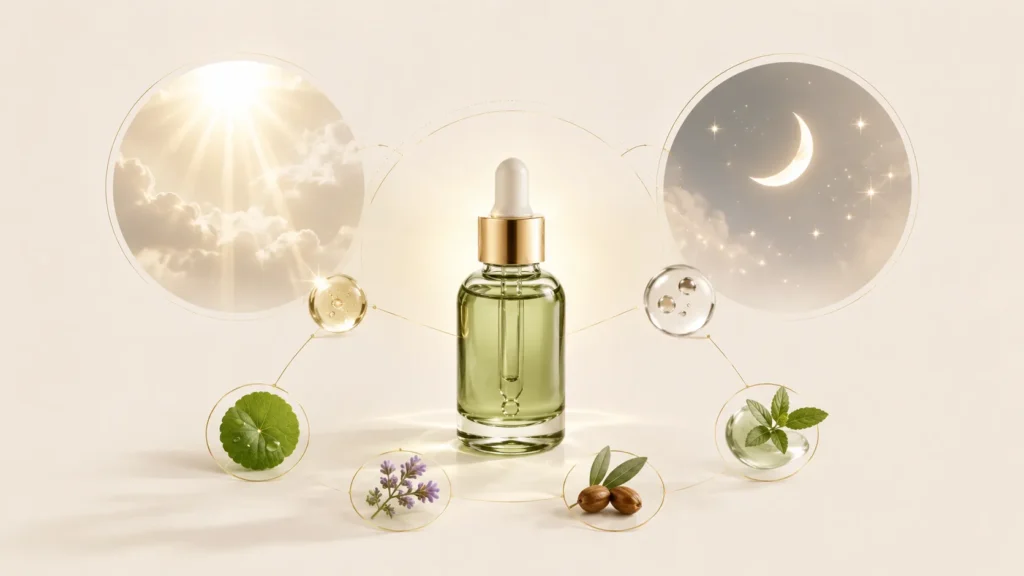
Bakuchiol is an easy ingredient to use. Apply it at the serum step after cleansing and toner, and finish with moisturizer. The big advantage: unlike retinol, you can use it in the morning. Its good photostability means morning and night both work. Just remember that even with morning use, sunscreen is separate and essential.
Combining it isn’t fussy either. It pairs well with vitamin C, niacinamide, and hyaluronic acid, so you can add it to most routines without trouble.
Routine order and ingredient pairing in detail → How to Use Bakuchiol: A Simple Routine Guide (2026)
Who it’s for, and how to choose
Bakuchiol suits these cases especially: sensitive skin that struggles with retinol’s irritation, wanting an anti-aging ingredient you can also use during the day, and skincare beginners. Its gentleness makes it easy to start with.
When choosing a product, check where “bakuchiol” sits on the ingredients list, what else is in it (hydrating or antioxidant ingredients), and whether the texture (serum or cream) suits your skin. It’s a gentle ingredient, but the overall formulation matters.
The formats and ingredients above are examples; individual results vary.
Pregnancy and nursing: always with a professional
One big reason bakuchiol draws attention is pregnancy and nursing. Because retinol is advised against during pregnancy, bakuchiol comes up as an alternative.
But this calls for caution. While bakuchiol is considered “lower-risk” than retinol, its safety during pregnancy is not “confirmed.” There isn’t enough research and experts disagree. So if you’re pregnant, nursing, or trying to conceive, decide only after consulting an OB-GYN or dermatologist.
This article is for information, not medical advice.
Frequently asked questions
Does bakuchiol work as well as retinol? In the 2018 trial, its improvements in wrinkles and pigmentation were comparable to retinol’s, with less irritation. But it has less accumulated evidence than retinol, so it’s most accurate to see it as a gentle alternative with similar effects.
Is bakuchiol a retinol? No. It’s neither vitamin A nor a retinoid, and it’s a different ingredient from retinol. It works through a different pathway but produces similar effects.
When and how do I use it? At the serum step after cleansing and toner. Its good photostability means you can use it morning and night; wear sunscreen during the day.
Can I use it during pregnancy? It’s considered lower-risk than retinol, but its safety isn’t confirmed. Always consult an OB-GYN or dermatologist.
Can I use it with retinol? Yes. Use them together or alternate via “cycling” to reduce irritation.
What skin is it for? It suits sensitive or reactive skin, anyone wanting daytime anti-aging, and beginners especially well.
The bottom line
Despite the “natural retinol” nickname, bakuchiol is an entirely different, plant-derived ingredient from retinol. What’s drawing attention is that clinical research shows it delivering retinol-like anti-aging benefits far more gently. If retinol’s irritation is a burden, you want something for daytime, or you’re new to skincare, it’s a good option. Understand it as a “gentle alternative” rather than a “full replacement,” and if you’re pregnant, consult a professional. Each topic is covered in more depth in the detailed guides above.