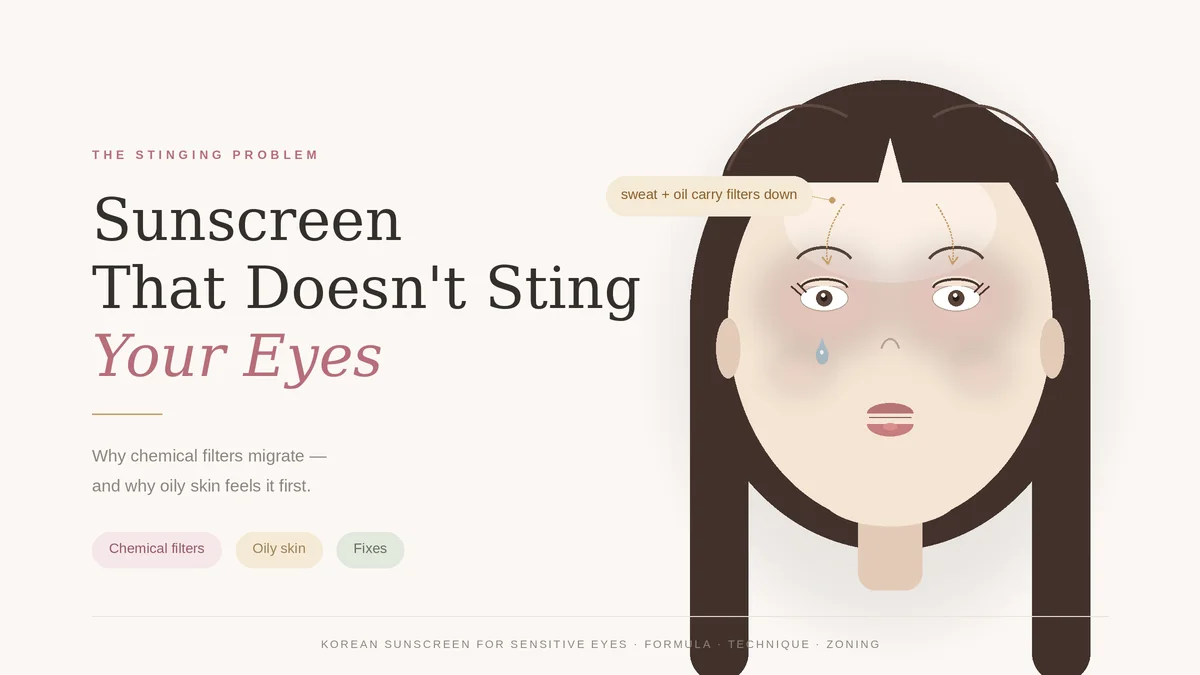
Ten minutes after you put it on, the burn starts. Your eyes water. Your vision blurs. You end up pressing the back of your hand against your eyelid at a crosswalk, blinking through the sting, wondering what exactly you did wrong. Break a sweat and it gets worse.
Plenty of people quit sunscreen entirely over this. Not because they don’t care about their skin — because they can’t see.
Here’s the thing: if you finally found a Korean sunscreen that goes on weightless and leaves no white cast, and it’s the one burning your eyes, that’s not bad luck. There’s a mechanism behind it, and there’s a way out.
The short answer — and the part nobody explains
Stinging eyes almost always trace back to chemical sunscreens. The filters dissolve in sweat and oil, migrate toward your eyes, and irritate the surface.
But here’s what most articles skip. Two people can use the exact same chemical sunscreen, and one is fine while the other is in tears. And the same sunscreen that behaves in winter turns brutal in July. Whatever’s driving that difference isn’t the bottle — it’s you. Once you understand what’s actually moving that filter across your face, you can fix this without giving up sunscreen at all.
Why sunscreen stings your eyes
Chemical filters absorb UV and release it as a small amount of heat. To do that job, they have to be oil-soluble — they need to dissolve into a formula that spreads across your skin. That property is exactly what makes them elegant to wear. It’s also what causes the problem.
Sweat and sebum dissolve those filters and carry them. The sunscreen you smoothed onto your forehead and eyelids doesn’t stay put. It rides oil and perspiration downward, pooling in the crease under your brow bone, then slipping into the eye itself. And the surface of your eye is nothing like the skin around it — it’s mucous membrane, wired to react to the tiniest foreign substance. A trace amount is enough.
Mineral sunscreens cause this far less. Zinc oxide and titanium dioxide sit on the surface as particles and reflect UV away. They don’t dissolve and travel the way chemical filters do, so they’re much less likely to find their way into your eyes.
New to the difference between these two filter types?
[Chemical vs Mineral Sunscreen: A Korean Skincare Guide (2026)]
Why oily skin makes it worse
This is the part almost nobody talks about, and it explains why the same product treats two people so differently.
If you have oily or combination skin, you will experience eye sting more often and more intensely. The logic is simple: the more sebum your skin produces, the more solvent there is to dissolve those chemical filters and move them. Add sweat and the odds of migration climb sharply. If you have an oily T-zone, picture the sunscreen on your forehead slowly creeping down toward your eyes as the hours pass. That’s essentially what’s happening.
Which sets up a genuinely cruel irony. Oily skin gravitates toward light, fresh, invisible chemical sunscreens — they don’t feel greasy, they don’t leave a cast, they sit beautifully under makeup. And those are precisely the formulas most likely to end up in your eyes. The texture you chose to solve one problem hands you another.
“As someone with oily combo skin, white cast was the least of my worries—eye stinging was the real dealbreaker. Ironically, the lighter and more transparent the chemical sunscreen, the worse my eyes burned. It was an absolute nightmare whenever I started sweating.”
Fix #1: Change the formula
The most reliable move is switching filter types.
Mineral (physical) sunscreen is the safest bet for stinging eyes. Yes, you trade some white cast for it — but if you’ve been avoiding sunscreen altogether, that’s a trade worth making. Modern mineral formulas are also far better milled than they were even a few years ago, so the cast isn’t what it used to be.
Sunscreen sticks let you apply with precision and stay put. Because they don’t run the way lotions and creams do, they’re a strong option around the eye area specifically.
Hybrid formulas combine mineral and chemical filters, and they frequently sting less than an all-chemical formula. If you want a middle path between white cast and eye sting, this is it.
Fix #2: Change how you apply it
You can solve much of this without changing products at all.
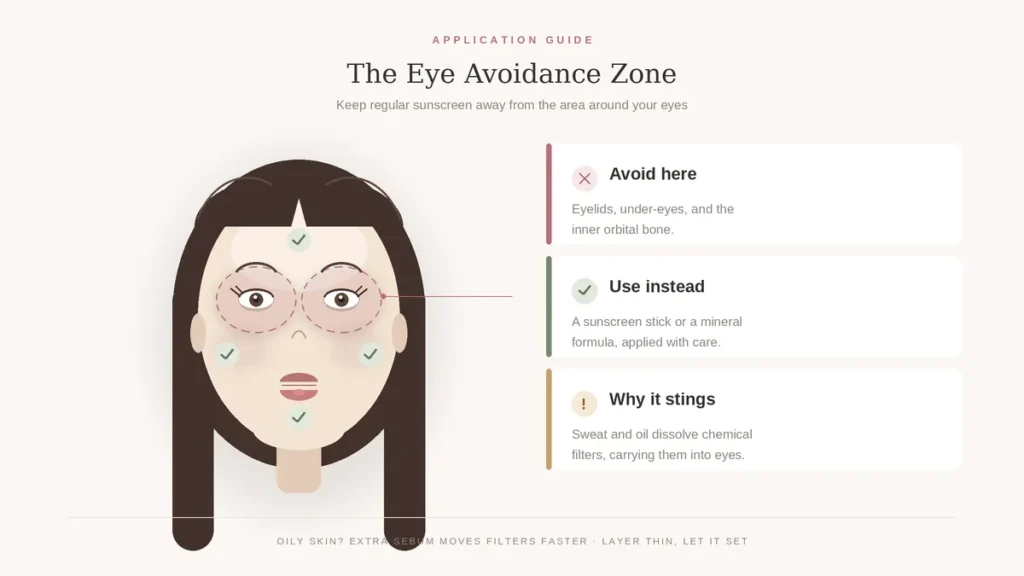
Respect the eye avoidance zone. Skip regular sunscreen on the eyelids, the under-eye area, and inside the orbital bone. Treat that zone separately with a stick or a mineral formula.
Apply thin, in layers. A thick single coat has more product available to migrate. Two thin layers move less.
Let it set before you go out. Chemical filters need time to settle. Break a sweat two minutes after applying and the filter goes straight where the sweat goes.
Blot sweat, don’t wipe it. Wiping physically pushes sunscreen toward your eyes. Press a tissue and lift.
If you still want to use chemical sunscreen
Not ready to give up that weightless, cast-free finish? You don’t have to. There’s a workaround people with sensitive eyes use constantly.
Zone your face. Use your chemical sunscreen everywhere except the eye area, and handle the eye zone with a stick or a mineral formula. Two products, two territories. It sounds fussy for about three days, and then it’s just your routine.
Match the product to the day. Chemical sunscreen for indoor days. Mineral or a stick when you know you’ll be outside and sweating. The filter that’s perfect at your desk isn’t the filter you want on a hike.
Frequently asked questions
Why does sunscreen hurt so much when it gets in my eyes?
The surface of your eye is mucous membrane, far more sensitive than skin. Chemical filters dissolved in sweat and oil only need to reach it in trace amounts to trigger stinging and watering.
Do mineral sunscreens sting your eyes?
Much less often than chemical ones, because the particles stay on the skin’s surface instead of dissolving and migrating. They can still cause irritation if sweat physically washes them into the eye.
I have oily skin and the sting is unbearable. What should I do?
Your sebum is dissolving and transporting the filters. Treat the eye area separately with a stick or mineral formula, apply thin layers elsewhere, and give it time to set before you head out.
Should I just skip sunscreen if it stings?
No. Eye sting is usually solvable through formula choice and application technique. Finding the right product is far better for your skin than going without protection.
The bottom line
Stinging eyes aren’t something you have to tolerate as the price of sun protection. Once you understand that chemical filters dissolve in sweat and oil and travel across your face, the fix becomes obvious: change the filter, change how you apply it, or zone your face so the eye area gets its own treatment. If you have oily skin, that last one alone can change everything.
Giving up sunscreen should be the very last option on your list. It shouldn’t even be on it.