You smooth on SPF 50 every morning. You never burn. You’ve done everything right — or so you thought. But what if, the entire time you were faithfully applying that sunscreen, your skin was quietly aging underneath it?
Here’s the uncomfortable truth: the SPF number does nothing to stop skin aging. SPF only handles one type of UV ray. The one that actually causes wrinkles and dark spots slips right past it. And the rating that measures protection against that ray is the strange little symbol on your Korean sunscreen — PA.
The short answer — and the part nobody explains
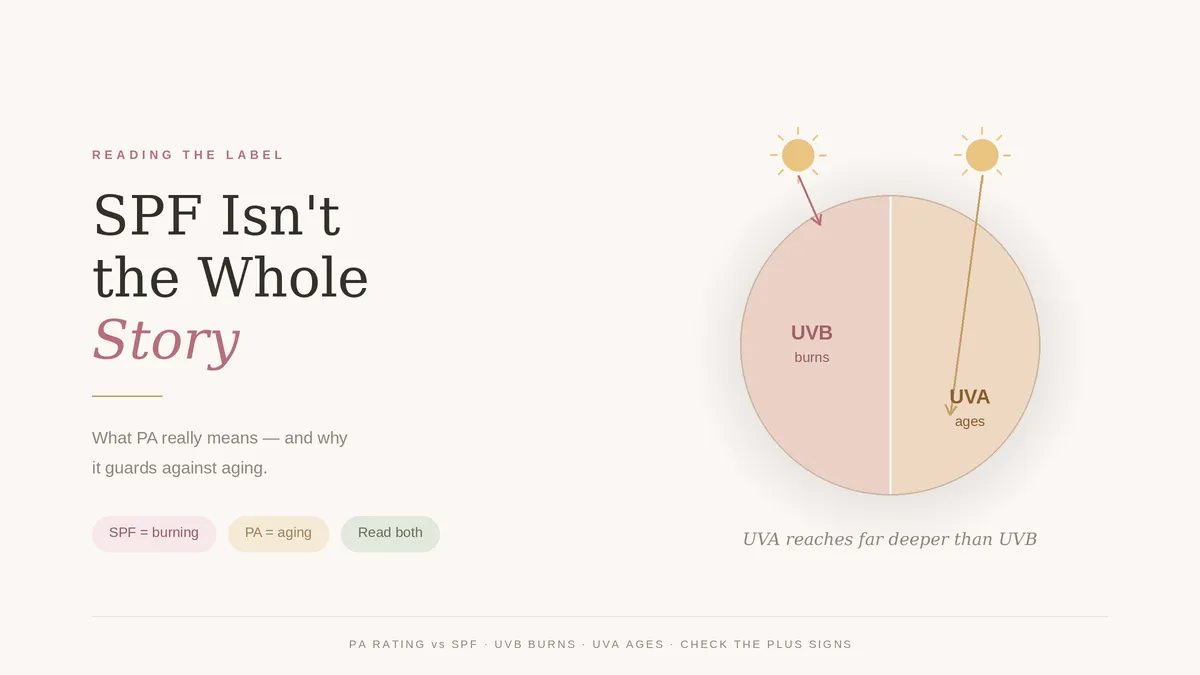
Put simply: SPF measures protection against UVB, and PA measures protection against UVA. UVB burns you. UVA ages you.
But here’s what’s strange. Korean and Asian sunscreens print that PA rating right on the front — yet on most American and European bottles, you can barely find it. Same sun, same rays. So why does only one side of the world label UVA protection? Once you know the answer, you’ll never read a sunscreen label the same way again.
What SPF really does — and doesn’t
SPF (Sun Protection Factor) is a number that tells you how well a sunscreen blocks UVB rays. UVB is short-wave and intense: it scorches the surface of your skin and causes burns and redness. That lobster-red glow after a day at the beach? That’s UVB at work.
Now here’s where almost everyone gets it wrong. SPF 50 is not twice as protective as SPF 30. SPF 30 blocks about 97% of UVB. SPF 50 blocks about 98%. The numbers look far apart, but the actual difference in protection is barely a percentage point. A higher number buys you a little more margin — not unlimited safety.
And crucially, SPF tells you nothing at all about UVA.
What PA actually is — and why the plus signs matter
PA (Protection Grade of UVA) measures protection against UVA rays, and it grades that strength with plus signs.
• PA+ — some UVA protection
• PA++ — moderate protection
• PA+++ — high protection
• PA++++ — very high protection (the highest grade there is)
Four pluses is the ceiling. So if you spot PA++++, that’s the strongest UVA defense on the shelf.
So why does UVA matter so much? UVA is long-wave, which means it penetrates deep into the dermis. It breaks down collagen, carves out wrinkles, triggers dark spots and pigmentation, and speeds up photoaging. And because it doesn’t burn you the way UVB does, it’s sneakier — you don’t feel the damage happening. It passes through windows. It’s there on overcast days. All the times you thought you were safe — indoors, no sun in sight — UVA was quietly accumulating.
In other words, wearing a sunscreen that’s all SPF and no UVA protection is like guarding against the sunburn while leaving the aging wide open.
Why only Korea and Asia use PA
This is the heart of it. And once again, the answer comes down to regulation.
Korea, Japan, and much of Asia built clear systems for labeling UVA protection as its own grade — the PA scale. A shopper can look at a number and know exactly how much UVA defense they’re getting.
The US takes a different path. It regulates sunscreen as a drug, but it has no strong requirement to show how much UVA a product blocks in a way consumers can compare. Instead, American bottles lean on one catch-all phrase — “broad spectrum” — which only tells you a product blocks some UVA. It never tells you how much. Europe uses PPD values or a star system, but it varies by country and brand.
So the PA rating on a Korean sunscreen isn’t marketing fluff. It’s a transparent readout of UVA defense. In an earlier post I explained why Korean sunscreens block UVA so well thanks to next-generation filters — the PA rating is simply the number that lets you see that performance for yourself.
Curious why Korean sunscreens are so strong on UVA?
Chemical vs Mineral Sunscreen: A Korean Skincare Guide (2026)
See it for yourself: how much is your sunscreen really blocking?
It’s hard to picture in the abstract. Pick an SPF and a PA rating below, and see what kind of protection you’re actually getting.
So what should you actually look for?
The key is to read SPF and PA together. A sunscreen that’s high in only one is half a defense.
• Everyday wear: SPF 30 or higher, plus PA+++ or higher, is plenty.
• Long hours outdoors: go for SPF 50 with PA++++.
• The golden rule: never judge a sunscreen by its SPF alone — always check the PA rating (or, at minimum, that it says broad spectrum).
The fact that a Korean sunscreen shows a PA rating is a genuine advantage: you get to see the UVA defense and choose accordingly. Now that you can read that label, you can pick a sunscreen that guards against wrinkles as deliberately as it guards against burns.
Frequently asked questions
Which matters more, PA or SPF?
Both. SPF handles burning (UVB); PA handles aging (UVA). A product that’s high in only one leaves you half-covered, so read the two ratings together.
How high does PA go?
Four plus signs — PA++++ — is the maximum, meaning very high UVA protection.
Why don’t US sunscreens have a PA rating?
Different regulation. The US uses the blanket term “broad spectrum” to indicate some UVA protection, rather than grading it in tiers the way PA does.
Is SPF 50 much safer than SPF 30?
The gap is smaller than it looks. SPF 30 blocks about 97% of UVB and SPF 50 about 98% — the protection doesn’t scale the way the numbers suggest.
The bottom line
Trusting a high SPF number alone is a habit worth breaking. UVB causes the burns; UVA drives the aging — and the PA rating is what tells you how well that aging is being held off. Once you can read the PA label on a Korean sunscreen, you’re protecting yourself against the damage you can’t see as much as the damage you can. Next time you’re choosing a sunscreen, check the plus signs next to the SPF.