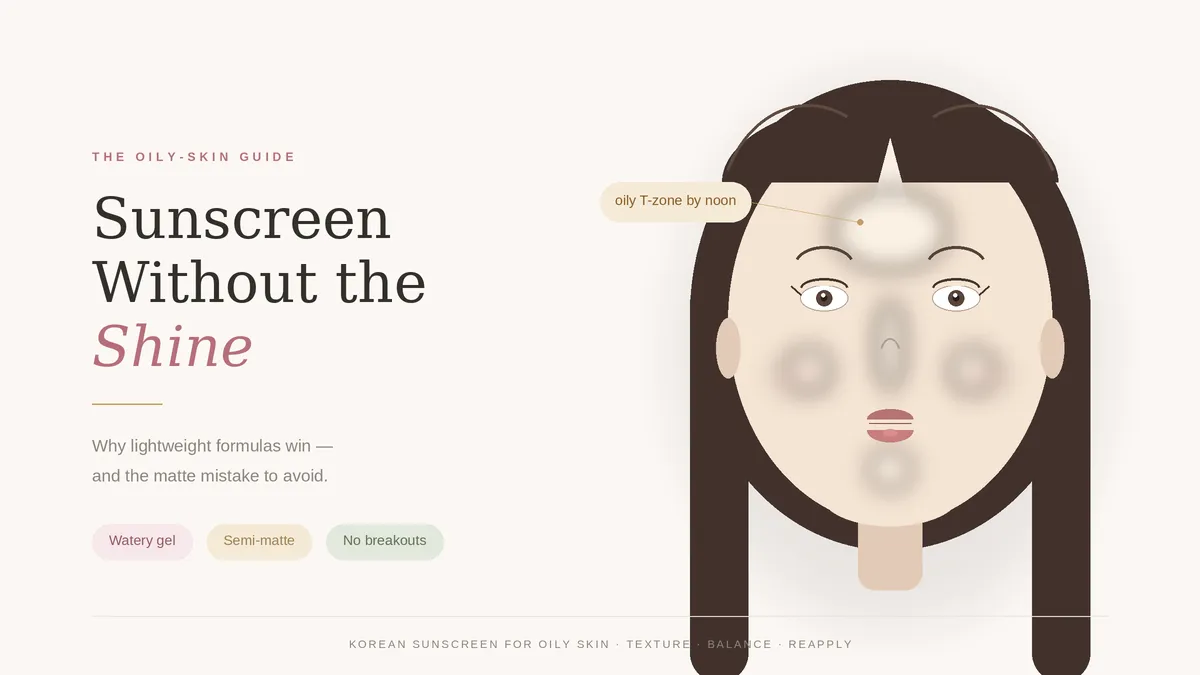
You apply your sunscreen carefully in the morning. It feels fresh. Then you catch your reflection around lunchtime, and your forehead and nose are shining, your makeup sliding off. If you have oily or combination skin, you know this frustration on repeat. So some people shrug and decide “that’s just how sunscreen is” — or skip it altogether.
But the problem usually isn’t sunscreen itself. It’s that you might be choosing the wrong one. And when it comes to oily skin, most people choose in exactly the wrong direction.
The short answer — and what most people miss
For oily and combination skin, a lightweight chemical sunscreen in a watery gel or serum texture is usually the best fit. It absorbs fresher than a heavy cream and looks far less greasy.
But here’s the trap. “I picked a light one and it still got shiny.” “I used a mattifying one and a few hours later my skin was an oil slick.” Sound familiar? Sunscreen failures on oily skin come as much from misunderstanding your own skin as from the product itself. Once you understand the mechanism, you can break the cycle.
What oily skin really struggles with
The complaints of oily and combination skin come down to three things.
Shine. Layer a heavy, oil-rich sunscreen onto skin that already produces a lot of sebum, and the product’s oils pile on top of your own. Your face turns into an oil slick fast.
Makeup breakdown. When your T-zone runs oily, whatever sunscreen and makeup you’ve layered on top slides and separates. That’s why it goes patchy after a few hours.
Breakouts. Heavy, pore-clogging textures can trigger congestion and bumps on oily, acne-prone skin.
So for oily skin, choosing a sunscreen comes down to one core question: how light is it, how quickly does it absorb, and how little does it burden your pores?
What to look for: texture
These textures tend to work well for oily skin.
Lightweight chemical filters. They apply fresher than mineral filters and leave no white cast, which suits oily skin. As covered earlier, Korean sunscreens are especially strong in these chemical, next-gen filter formulas.
Watery gel and serum textures. They absorb like water, so there’s minimal shine — hydration without the greasy feel. That fits oily skin’s real dilemma perfectly: “I hate tightness, but I hate shine too.”
Semi-matte to matte finish. A fresh finish helps keep oil in check. That said, an obsession with matte can backfire — more on that below.
Not sure which suits you, chemical or mineral? Here’s the breakdown
→ Chemical vs Mineral Sunscreen: A Korean Skincare Guide (2026)
What to avoid
On the flip side, here’s what oily skin should be cautious of.
Heavy, oil-rich creams. Rich moisturizing sunscreens made for dry skin bring shine and breakouts to oily skin.
Too many oils. Products with oils high on the ingredient list can feel like a burden on oily skin.
Eye-sting triggers. Oily skin produces more sebum and sweat, which makes chemical filters more likely to migrate toward the eyes. If stinging is a frequent issue for you, factor that in too.
More on why oily skin gets stinging eyes
→ Korean Sunscreen for Sensitive Eyes That Stops the Sting
“Honestly, the struggle is so real. By 2 PM, my T-zone is basically a disco ball. This is exactly why I’m so picky with textures. I need something that takes the edge off the oil without making my face look flat, so I can actually stay fresh all day.”
3 mistakes oily skin often makes
This is the part most people miss. Even with a good product, these mistakes will keep the shine coming.
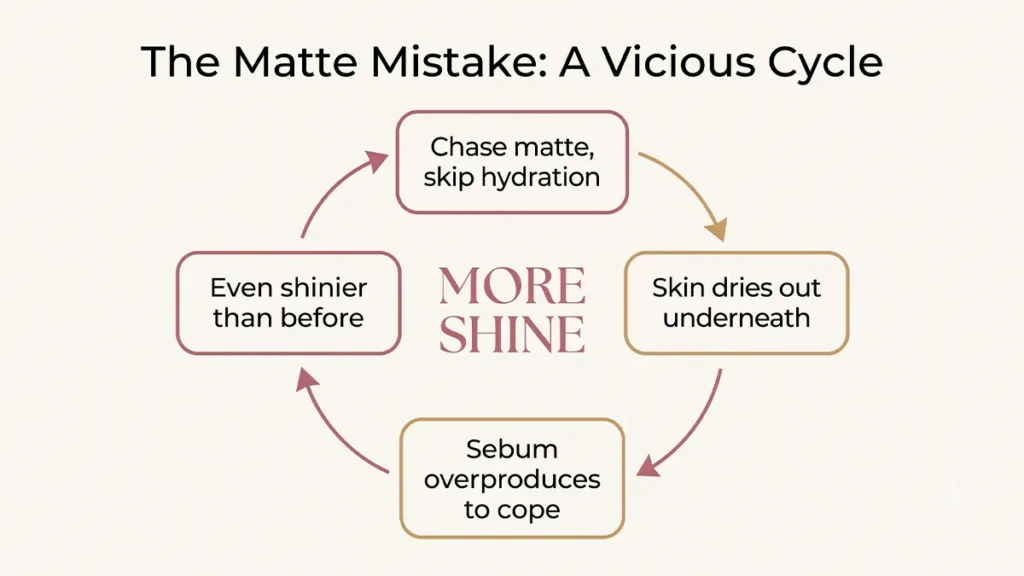
Mistake 1: Chasing matte and neglecting hydration.
The most common trap. If you only hunt for mattifying products and skimp on hydration, your skin tries to compensate for the lack of moisture by pumping out more oil. The result is a shinier vicious cycle. For oily skin especially, the key is balance — lower the oil, but keep the hydration up.
Mistake 2: Using less because you hate the shine.
Apply too little sunscreen and the shine drops, but so does your UV protection — sharply. You have to use the minimum amount for real protection. Solve shine through texture, not by under-applying.
Mistake 3: Not reapplying.
Oily skin breaks sunscreen down faster with oil and sweat. To keep protection up, you need to reapply — but shine makes people skip it. A powder or cushion-format reapply product lets you manage oil and protection at the same time.
Textures often recommended for oily skin
The following are examples of texture types said to suit oily and combination skin. Confirm what works with your own skin’s response.
Watery sun-gel textures — light and fresh like water, generally comfortable for oily and combination skin. Korean sunscreens offer plenty of these.
Serum-type sunscreens — absorb thin like a skincare serum with minimal shine; versions with soothing ingredients tend to sit easier on breakout-prone skin.
Gel and water-based chemical filters — finish fresh without a greasy feel, and are frequently mentioned as a daily option for oily skin.
Frequently asked questions
For oily skin, is chemical or mineral sunscreen better?
Usually a lightweight chemical formula. It absorbs fresher than mineral and leaves no white cast, which suits oily skin. If you’re also sensitive, a gentle hybrid is worth considering.
Is a matte sunscreen the best way to cut shine?
Not necessarily. Fixating on matte and neglecting hydration can actually trigger more oil. A semi-matte to hydrating texture that lowers oil while keeping moisture up is the better balance.
Do I really need to reapply sunscreen if I have oily skin?
Yes. Oil and sweat break sunscreen down faster, so reapplying keeps protection intact. If the shine bothers you, use a powder or cushion format.
Can sunscreen cause breakouts on oily skin?
Heavy, pore-clogging textures can. A light gel or serum texture labeled non-comedogenic tends to be less of a burden.
The bottom line
Having oily or combination skin doesn’t mean sunscreen has to be the source of your shine. Two things matter: choosing a light, fresh texture, and avoiding the common mistakes — chasing matte, under-applying, skipping reapplication. Once you understand the balance of lowering oil while keeping hydration up, you can protect your skin every day without turning into an oil slick by lunch.