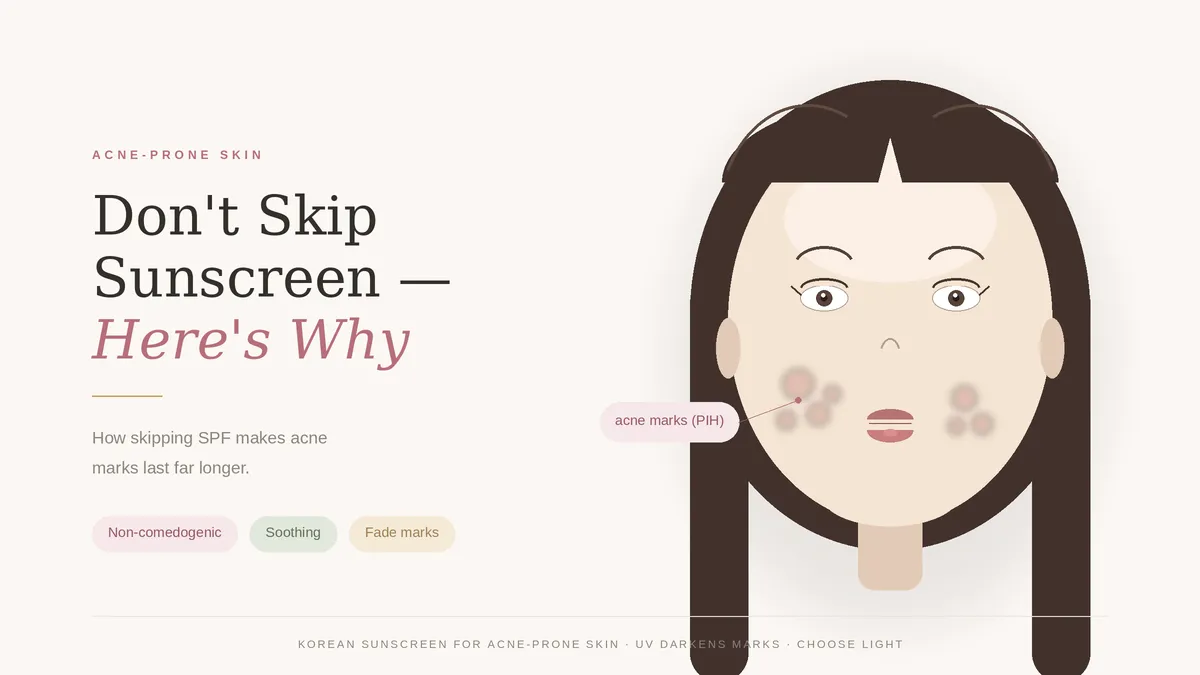
If you break out easily, sunscreen probably comes with a fear attached: “Won’t this clog my pores and cause even more acne?” So on the days your skin is at its worst, you skip it entirely.
Here’s the uncomfortable truth: skipping sunscreen is what makes acne marks last longer. The choice you made out of worry ends up worsening the very thing acne leaves behind. Let’s look at why — and how acne-prone skin should actually choose a sunscreen.
Note: this article is information about choosing sunscreen, not medical advice. For severe acne, consult a dermatologist.
The short answer — and what’s easy to miss
Acne-prone skin generally does best with a lightweight, non-comedogenic formula that uses low-irritation ingredients often chosen for their soothing role.
But there’s a trap. Grabbing anything labeled “for acne-prone skin,” or avoiding sunscreen out of fear, can both backfire. The key is understanding why sun protection matters for acne-prone skin in the first place. Once that clicks, the criteria become obvious.
Why sun protection matters for acne-prone skin
Even after a breakout calms down, it often leaves a brown or red mark behind. This is called post-inflammatory hyperpigmentation (PIH).
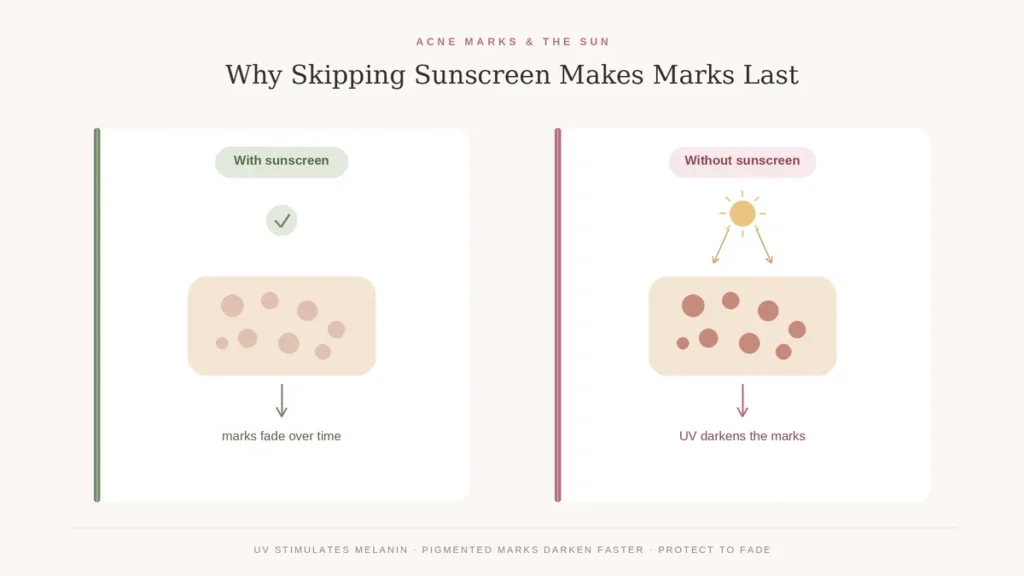
Here’s the important part: those marks tend to darken and linger longer when exposed to UV. Sunlight stimulates melanin production, and areas that are already pigmented react more strongly to that trigger. So when you skip sunscreen because you’re worried about breakouts, the marks left behind stick around far longer — separate from the acne itself.
In other words, for acne-prone skin, sunscreen isn’t something to avoid for fear of causing breakouts — it’s closer to something worth keeping up specifically to keep acne marks from darkening. Provided, of course, you’ve chosen a formula that doesn’t clog your pores.
What to look for
The criteria for acne-prone skin.
Non-comedogenic. A label indicating the product is formulated not to clog pores. If you’re acne-prone, this is less of a burden on your skin.
A lightweight texture. A watery gel or serum that absorbs light — rather than a heavy cream — reduces pore burden and shine.
Ingredients often used for soothing. Centella (cica), houttuynia, and madecassoside are frequently used in Korean sunscreens for calming stressed skin — part of why Korean sunscreens drew attention in the West for breakout-prone care. (Results vary from person to person.)
Not sure whether chemical or mineral suits you?
→ Chemical vs Mineral Sunscreen: A Korean Skincare Guide (2026)
What to avoid
On the flip side, what acne-prone skin should be cautious of.
Heavy, pore-clogging oils. Rich, oil-heavy textures can trigger breakouts.
Potential irritants. Fragrance, certain alcohols, and harsh ingredients can burden already-sensitized skin.
Sting and irritation triggers. Breakout-prone skin is often already reactive, so a gentle formula with fewer irritants is the safer choice.
“The breakout struggle is so real—you want to skip sunscreen so bad, but you know those hyperpigmentation marks will haunt you later. So now I’m strictly on a ‘gentle, lightweight formulas only’ diet.”
3 mistakes acne-prone skin often makes
Even with a good product, these mistakes can make skin worse.
Mistake 1: Skipping sunscreen out of fear of breakouts.
As covered above, this is exactly what makes acne marks linger. The answer isn’t to avoid sunscreen — it’s to choose a formula that doesn’t clog pores.
Mistake 2: Over-exfoliating, then going unprotected.
Using strong exfoliants or acids to fight acne and then neglecting sun protection leaves the thinned, vulnerable skin more exposed to irritation and pigmentation. Sun protection matters more after exfoliation, not less.
Mistake 3: Fixating on brightening products for the marks.
Applying brightening products to fade acne marks while skipping sun protection means that as one side lightens them, UV is darkening them on the other. Without sun protection underneath, it’s hard to see results.
Textures and ingredients often mentioned for acne-prone skin
The following are examples of types said to suit acne-prone skin; individual results vary. For severe breakouts, consult a professional.
Serum-type sunscreens with soothing ingredients — formulas with calming ingredients like centella that absorb lightly are frequently recommended for breakout-prone skin.
Watery gel textures — finish fresh without a greasy feel and tend to be lower burden on pores.
Products labeled non-comedogenic — formulated not to clog pores, and a common baseline choice for acne-prone skin.
Frequently asked questions
Does sunscreen really cause acne?
Heavy, pore-clogging textures can, but lightweight non-comedogenic formulas are less of a burden. Texture choice is the key.
I have acne marks — does sunscreen help?
UV tends to darken pigmented marks, so sun protection helps keep them from darkening. That said, sunscreen doesn’t treat or remove the marks themselves.
For acne-prone skin, is chemical or mineral sunscreen better?
It varies. Some prefer a lightweight chemical formula; others do better with a gentle mineral or hybrid. Look at whether it’s non-comedogenic and check for irritants.
My breakouts are severe — is it okay to wear sunscreen?
A gentle, lightweight formula is usually fine, but if your acne is severe or under treatment, it’s safest to consult a dermatologist about a product suited to your specific condition.
The bottom line
For acne-prone skin, sunscreen isn’t an enemy to avoid. Choose a formula that doesn’t clog your pores, and it becomes a reliable step that keeps acne marks from darkening under UV. Go for a lightweight, non-comedogenic texture, and steer clear of the common mistakes — skipping sunscreen, over-exfoliating, fixating on brightening. When breakouts are severe, folding in professional advice is the safest route of all.