Korean sunscreen has won over beauty communities around the world. Light, invisible, and pleasant enough to wear that people describe it as feeling like skincare rather than a chore. But the moment you go to buy one, there are too many options, that PA symbol next to the SPF looks unfamiliar, and it’s hard to know what actually suits your skin.
This guide pulls it all together in one place: why Korean sunscreen is different, how to read the label, and — most importantly — how to choose the right one for your skin concern. Get the big picture here, then follow the links to go deeper on whatever matters to you.
Why Korean sunscreen is different
There’s a reason Korean sunscreens feel so light and invisible, and it isn’t marketing. It’s regulation.
The US regulates sunscreen as an over-the-counter drug, so UV filters need FDA approval — and the FDA hasn’t cleared a meaningful new filter since the late 1990s. Korea, by contrast, classifies sunscreen as a functional cosmetic, which gives formulators far more freedom. Korean brands have used next-generation filters like Tinosorb and Uvinul for years, and those filters are lighter, clearer, and stronger on UVA protection.
In short, Korean sunscreen feels like skincare because regulation lets it use more modern filters.
Want the full breakdown of chemical vs mineral filters?
→ Chemical vs Mineral Sunscreen: A Korean Skincare Guide (2026)
Sunscreen basics: how to read SPF and PA
The first time you see something like “SPF50+ PA++++” on a Korean sunscreen, it can be confusing. It’s simple once you know the essentials.
SPF measures protection against UVB — the rays that burn. SPF 30 blocks about 97% of UVB, SPF 50 about 98%. The gap is smaller than the numbers suggest.
PA measures protection against UVA — the rays that drive aging and pigmentation. It’s shown in plus signs, with PA++++ being the highest grade. UVA doesn’t burn you visibly, but it penetrates deep into the dermis and causes wrinkles and dark spots, which is why this rating matters.
So a sunscreen that’s high in SPF alone can guard against burning while missing aging. You need to read both.
More on SPF and PA — and why Western sunscreens don’t show a PA rating
→ PA Rating vs SPF: What Korean Sunscreen Labels Actually Mean (2026)
Chemical vs mineral vs hybrid
Sunscreens differ by how they block UV.
Chemical sunscreen absorbs UV and converts it to heat. It’s clear and lightweight with no white cast — an area where Korean sunscreens shine.
Mineral sunscreen uses zinc oxide and titanium dioxide particles to reflect UV. It’s gentle, but comes with white cast and a heavier feel.
Hybrid blends the two, balancing gentleness with a clear finish.
Which one suits you depends on your skin type and concern — which is exactly what we’ll break down next.
Choosing by skin concern
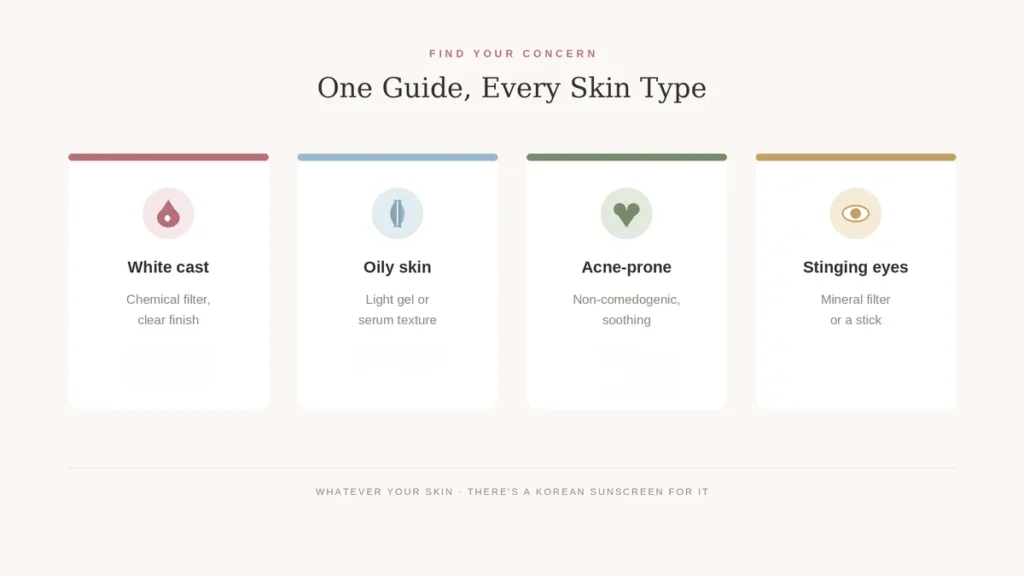
This is the heart of the guide. Find your concern, check the direction and an example product, then follow the link for the full details.
The products below are examples frequently mentioned for each concern; individual results vary. Confirm specs before buying.
If you’re worried about white cast
If you have a deeper skin tone or dislike a pale residue, a chemical sunscreen absorbs clear. Beauty of Joseon Relief Sun (Rice + Probiotics, SPF50+ PA++++), for example, is frequently cited as a hydrating chemical formula that finishes without a cast.
Read more → Korean Sunscreen With No White Cast: The Complete Guide (2026)
If you have oily or combination skin
If shine is your concern, a lightweight watery gel or serum texture stays fresh. Isntree Hyaluronic Acid Watery Sun Gel, for instance, is often recommended for oily and combination skin for how light it feels. Just remember that fixating on matte while neglecting hydration can actually increase oil, so balance matters.
Read more → Best Korean Sunscreen for Oily Skin: How to Choose (2026)
If you have acne-prone skin
If breakouts worry you, a lightweight, non-comedogenic formula with soothing ingredients is less of a burden. SKIN1004 Madagascar Centella sunscreens, for example, are often mentioned for their centella content and light, serum-like absorption. And note: acne marks darken under UV, so skipping sunscreen out of fear of breakouts actually makes those marks linger. (For severe acne, consult a dermatologist.)
Read more → Korean Sunscreen for Acne-Prone Skin: How to Choose (2026)
If sunscreen stings your eyes
If sunscreen makes your eyes sting, a mineral formula or a stick is a good alternative. The cause is chemical filters dissolving in sweat and oil and migrating toward the eyes — and mineral filters migrate far less. Oily skin tends to sting more because of extra sebum, so treating just the eye area with a stick works well too.
Read more → Korean Sunscreen for Sensitive Eyes That Stops the Sting
See it for yourself: how much is your sunscreen blocking?
Pick your SPF and PA below and see how much protection you’re actually getting.
Sunscreen application basics
Even a great sunscreen depends on how you apply it.
Use enough. Applying too little tanks your protection. Even if you dislike the shine, keep the amount and solve texture with the formula.
Apply thin, in layers. Two thin layers beat one thick coat — less white cast, less migration, less pilling.
Reapply. Sunscreen breaks down over time. Especially for oily skin or outdoor activity, a powder or cushion format keeps protection up.
Let it absorb before heading out. Chemical filters in particular need time to settle.
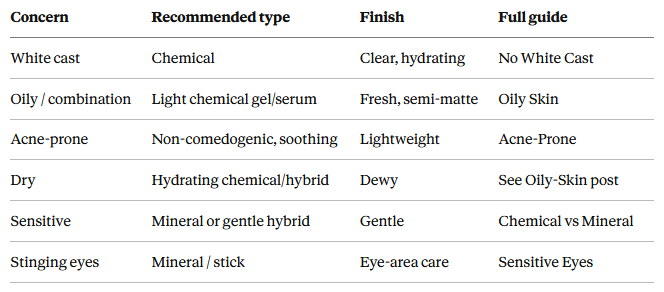
Quick reference by skin type
Frequently asked questions
Is Korean sunscreen really better? Thanks to regulation, Korean brands can freely use lighter, more modern filters, which gives them an edge in feel and UVA protection. That said, it’s less about “always best” and more about choosing the formula that suits your skin.
Should I look at SPF or PA? Both. SPF handles burning (UVB); PA handles aging (UVA). High in only one means half-protected, so check them together.
I have oily skin — what should I choose? A lightweight watery gel or serum-texture chemical sunscreen is usually fresh. See the oily-skin guide for details.
How often should I reapply sunscreen? It depends on your activity and environment, but during long hours outdoors or heavy sweating you need to reapply to keep protection intact. Mostly indoors, you can reapply less often.
The bottom line
Korean sunscreen’s strength lies in the modern filters that regulation opened up — which is why so many are light and invisible while still protecting well against UVA. The key is to read SPF and PA together and choose a texture that fits your skin concern. Whether it’s white cast, shine, breakouts, or stinging eyes, there’s an answer for each. Find your concern in the detailed guides above.
1 thought on “Best Korean Sunscreen 2026: The Complete Guide”