Vitamin C is considered a “must-have” in skincare — shorthand for bright, firm skin. But when you actually go to buy one, it’s confusing. L-ascorbic acid? Derivatives? And then there’s the talk that “it turns brown once you open it.” Why is it so complicated?
There’s a reason. Vitamin C is an ingredient whose benefits are clear, but which is tricky to handle.
The short answer
First, to clear it up: vitamin C is a potent antioxidant said to brighten and protect skin and support collagen. The evidence for its benefits is solid. The catch is stability. Because vitamin C degrades easily, which form you use and how you store it determine how well it works. Understand that, and you can choose and use vitamin C well.
What exactly is vitamin C?
Vitamin C is a water-soluble antioxidant vitamin and one of the most-researched ingredients in skincare. Its purest, most potent form is “L-ascorbic acid.”
It works in three main ways. As an antioxidant, it neutralizes the free radicals created by UV and pollution; it acts as a co-factor that helps build collagen; and it inhibits the enzyme that makes melanin (tyrosinase) to fade pigment.
Three key benefits
Brightening. It’s said to improve dark spots and dullness by inhibiting melanin production.
Antioxidant protection. It neutralizes free radicals from UV and pollution to defend against environmental damage. That’s why using it in the morning helps with daytime protection.
Collagen support. It helps collagen synthesis, playing a role in firmness and fine lines.
Changes typically show over 4–12 weeks, with individual variation.
Types: pure L-ascorbic acid vs derivatives
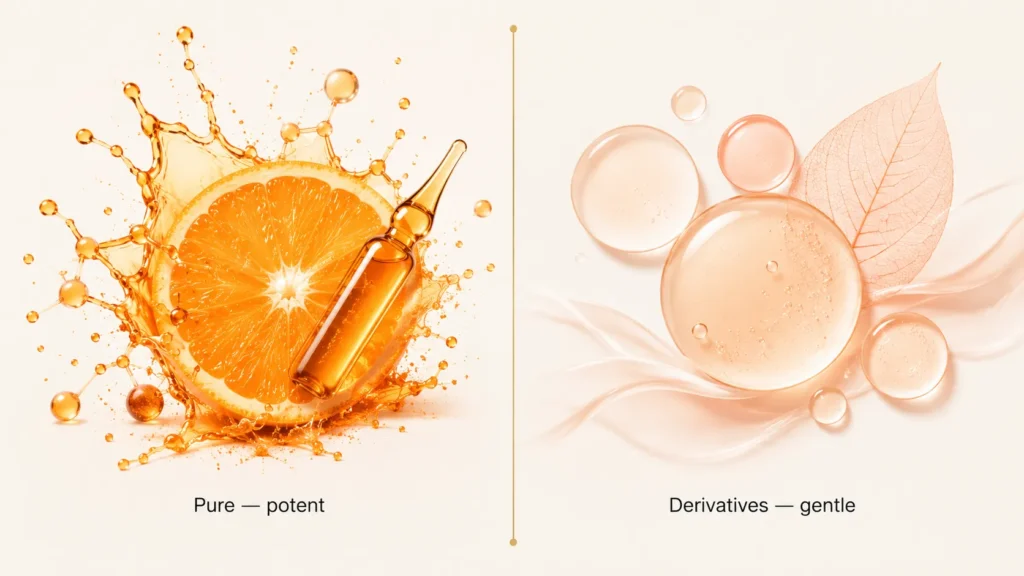
The biggest reason vitamin C products are confusing is that there are several forms. They fall into two broad groups.
Pure L-ascorbic acid. The most potent, most-researched form. But it’s the most unstable, degrading easily, and at higher concentrations (especially above 15–20%) it can be irritating. It works at a low pH, which can be hard on sensitive skin. In a word, it’s the “powerful but tricky” form, suited to experienced users.
Derivatives. SAP, MAP, ascorbyl glucoside, ascorbyl tetraisopalmitate, and others. They convert into L-ascorbic acid in the skin. They’re more stable and gentler than the pure form, but generally less potent because of that conversion step. They’re good for sensitive skin and beginners. SAP and MAP in particular are gentle, and the oil-soluble ascorbyl tetraisopalmitate suits dry skin.
So “potency” and “stability/gentleness” are generally a trade-off.
The stability issue: if it browns, toss it
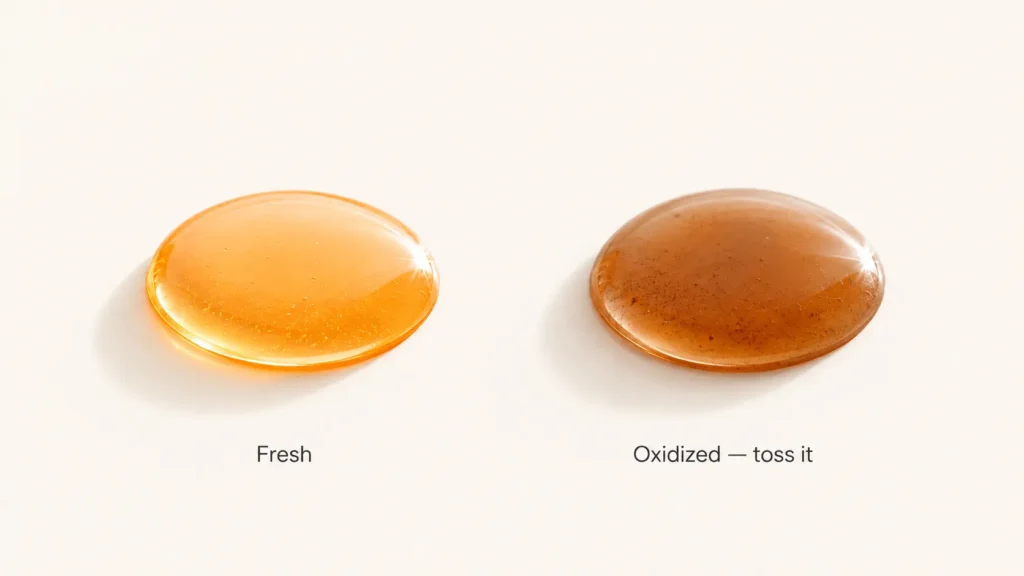
This is the most practical part of understanding vitamin C. Pure L-ascorbic acid especially oxidizes easily when exposed to light, air, and heat.
How do you know it’s oxidized? Look at the color. If a product that was clear or pale has turned deep brown or orange, that’s usually a sign it has oxidized and lost potency. Such a product not only works less well but can also irritate skin, so it’s best to replace it.
That’s why good vitamin C products come in opaque or airless packaging and often include stabilizers like vitamin E or ferulic acid. Store it somewhere cool and out of the light.
Concentration and pH
It’s easy to think “higher concentration is better,” but here too, that’s not the case.
Pure L-ascorbic acid is generally used in the 10–20% range — higher is more potent but also more unstable, with greater irritation risk. Above 15–20% can be hard on reactive skin. If you’re new to it, starting at a lower concentration (around 10%) or a gentle derivative is safer.
The key isn’t “the highest concentration,” but finding a form and concentration your skin tolerates and can use consistently.
Who it’s for, and how to use it
Vitamin C is a good choice if dullness, dark spots, or environmental protection are your concerns. If your skin is sensitive, a gentle derivative beats a pure, high-concentration form.
The key to using it is mornings. Since vitamin C’s antioxidant action helps defend against UV and pollution through the day, it fits a morning routine well. Apply it after cleansing and toner, let it absorb, and then always apply sunscreen last. Vitamin C doesn’t replace sun protection — rather, protection is stronger when it’s paired with sunscreen.
Comparison and pairing with niacinamide → Niacinamide vs Vitamin C: Can You Use Both? (2026)
Curious about sun protection? → Best Korean Sunscreen 2026: The Complete Guide
Patch-test any new product on your inner arm first. This article is for information, not medical advice.
Frequently asked questions
What does vitamin C do? It brightens skin, defends against environmental damage with antioxidants, and supports collagen. It’s said to fade pigment by inhibiting the melanin-making enzyme (tyrosinase).
What’s the difference between L-ascorbic acid and derivatives? Pure L-ascorbic acid is the most potent but unstable and can be irritating. Derivatives are gentler and more stable, but generally less potent because of the conversion step.
It’s turned brown — can I still use it? That’s a sign it has oxidized. It can be less effective and irritating, so it’s best to replace it.
Should I use it in the morning or at night? Mornings are recommended — the antioxidant action helps with daytime protection. Apply sunscreen on top.
Is a higher concentration better? No. Higher raises the risk of irritation and instability. Beginners should start at a lower concentration or a gentle derivative.
What should sensitive skin use? Gentle derivatives like SAP or MAP over a pure, high-concentration form.
The bottom line
Vitamin C is a powerful ingredient spanning brightening, antioxidant protection, and collagen — but the key is that it’s “tricky.” Pure L-ascorbic acid is potent but unstable; derivatives are gentle but weaker. The know-how: if it browns, toss it; store it somewhere cool; and use it in the morning with sunscreen. Rather than chasing the highest concentration, choosing a form that suits your skin and using it consistently is the way to make the most of vitamin C.