When you go to pick a vitamin C product and read the ingredients, it’s baffling. One says “L-ascorbic acid,” another “SAP,” another “MAP” or “ascorbyl glucoside.” These are all vitamin C? Yes, they are. They’re all vitamin C — just in different forms.
And the difference between these forms determines which product is right for you.
The short answer
Broadly, here’s the split. Vitamin C comes in one “pure” form (L-ascorbic acid) and several “derivatives.” The pure form is the most potent but can be unstable and irritating; derivatives are gentler and more stable but generally less potent. In other words, it’s a choice between “potency” and “gentleness/stability.”
Let’s look at which suits you, form by form.
Pure L-ascorbic acid: the gold standard
L-ascorbic acid is vitamin C’s “pure” form and the gold standard. It’s the most potent, with the most accumulated research on antioxidant, brightening, and collagen benefits.
Its downsides are as noted earlier. It oxidizes easily in light, air, and heat (browning), and it needs a low pH to work — which can be irritating. Higher concentrations especially (above 15–20%) can be hard on reactive skin. In a word, it’s the “most potent but highest-maintenance” form, suited to people already comfortable with vitamin C.
Why derivatives exist
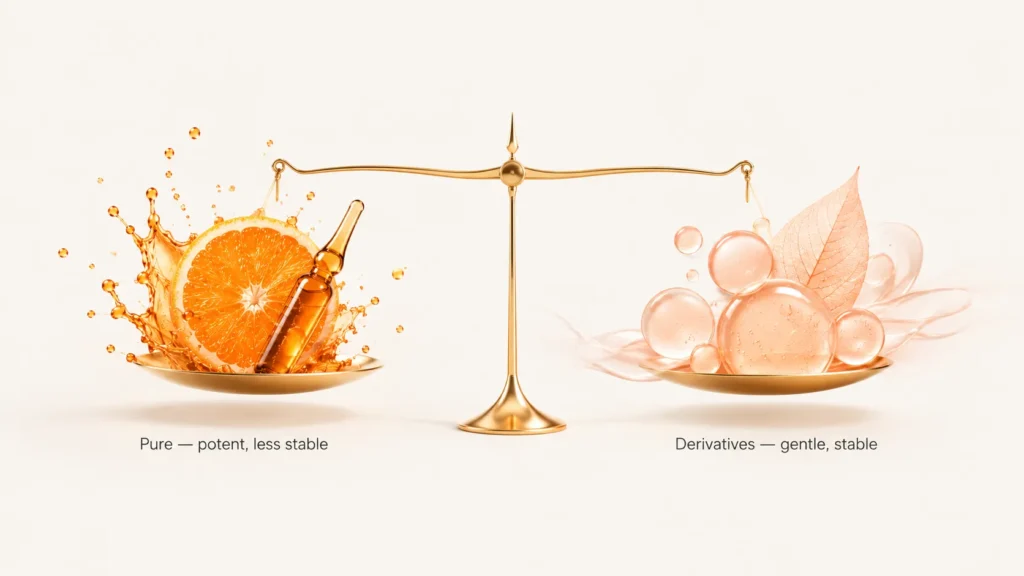
Derivatives are forms created to make up for pure L-ascorbic acid’s downsides (instability, irritation). They’re chemically modified to be more stable or gentler.
Here’s how they work. A derivative is absorbed into the skin and then converts into L-ascorbic acid to take effect. That makes them more stable and gentler, but because of that conversion step, they’re generally weaker or slower than the pure form. It’s a “give up a little strength to gain gentleness and stability” trade.
The main derivatives, one by one
Here are the key derivatives.
SAP (sodium ascorbyl phosphate). A water-soluble derivative that’s gentle and stable. It has a calming tendency, so it suits breakout-prone or sensitive skin.
MAP (magnesium ascorbyl phosphate). Also water-soluble, gentle, and stable, with a hydrating feel that suits sensitive and dry skin. It’s one of the most-researched derivatives.
THD (ascorbyl tetraisopalmitate). An oil-soluble derivative that’s stable and penetrates well. It blends with oils, suiting dry skin. This one is also well-researched.
Ascorbyl glucoside. Gentle and stable, so it’s low-burden for vitamin C beginners.
Ethyl ascorbic acid (3-O-ethyl ascorbic acid). Stable yet relatively strong, with fast absorption.
Side by side
| Form | Strength | Stability | Best for |
|---|---|---|---|
| Pure L-ascorbic acid | Strongest | Low — browns easily | Tolerant, experienced skin |
| SAP | Moderate | High | Breakout-prone, sensitive |
| MAP | Moderate | High | Sensitive, dry |
| THD | Moderate–strong | High | Dry skin (oil-soluble) |
| Ascorbyl glucoside | Gentle | High | Beginners |
| Ethyl ascorbic acid | Fairly strong | High | Fast absorption |
So which should you choose?
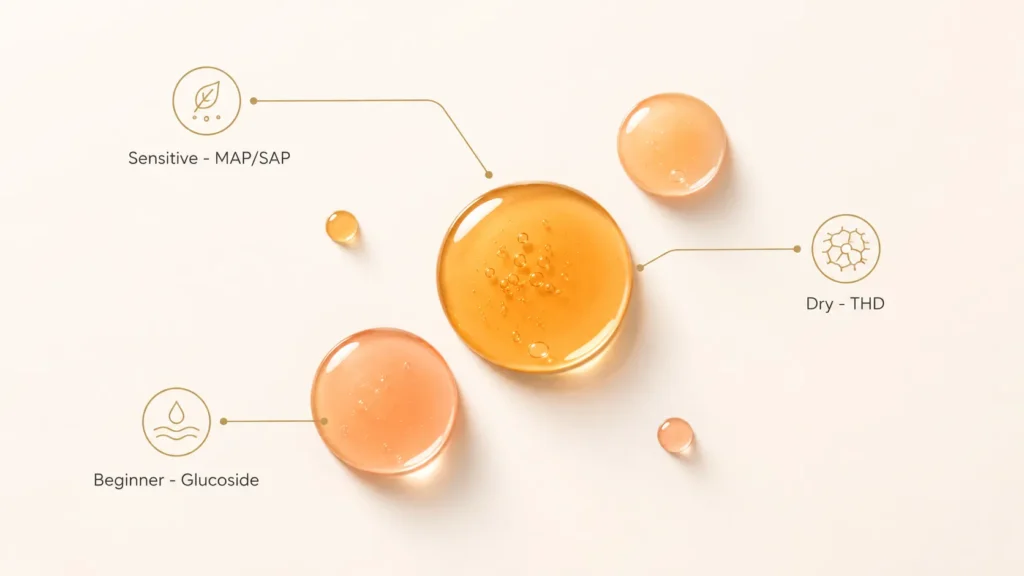
There are many forms, but by skin and experience it’s simple.
If you want strong results and are used to actives: pure L-ascorbic acid (10–20%). It’s the gold standard.
If your skin is sensitive or reactive: MAP or SAP. Gentle and stable.
If your skin is dry: THD (oil-soluble) blends well with oils.
If you’re new to vitamin C: start with ascorbyl glucoside or a low concentration of a gentle derivative.
The answer isn’t a single one — it’s choosing the form that fits your skin and goals. Whatever the form, the same principles apply: if it browns, replace it, and pair it with sunscreen in the morning.
New to vitamin C? → What Is Vitamin C Serum? Types, Benefits & Stability (2026)
Pairing with niacinamide → Niacinamide vs Vitamin C: Can You Use Both? (2026)
Patch-test any new product on your inner arm first. This article is for information, not medical advice.
Frequently asked questions
Are SAP and MAP all vitamin C? Yes. They’re all vitamin C derivatives. They differ in form from pure L-ascorbic acid but act as vitamin C in the skin.
Which is better — pure or a derivative? It’s a choice, not a ranking. Potency goes to pure; gentleness and stability to derivatives. Choose by your skin and experience.
Are derivatives ineffective? No. They convert into L-ascorbic acid in the skin. They may be weaker or slower than the pure form, but they’re gentler and more stable.
What should sensitive skin use? Gentle water-soluble derivatives like MAP or SAP.
What about dry skin? Oil-soluble derivatives like THD blend well with oils and suit it.
I’m new to vitamin C — where do I start? Ascorbyl glucoside or a low concentration of a gentle derivative is lower-burden.
The bottom line
Vitamin C comes in many forms to give you options between “potency and gentleness.” Pure L-ascorbic acid is potent but high-maintenance; derivatives (SAP, MAP, THD, and others) are gentle and generally act more softly. Sensitive → MAP/SAP; dry → THD; want potency → pure; beginner → glucoside. Even if the ingredient names are unfamiliar, with one guiding principle — “the form that fits my skin” — it isn’t hard.