When you go looking for an ingredient to calm sensitive skin, two names always come up: cica and snail mucin. Both are famous for being gentle, and both headline K-beauty’s soothing lines. Which leads to the question: “They’re both soothing ingredients — so what’s the difference?”
As it turns out, as much as they overlap, they have different strengths.
The short answer — and what’s easy to miss
Here’s the verdict: both are gentle soothing ingredients, but they have different focuses. Cica is strong at calming redness and irritation and repairing the barrier; snail mucin is strong at delivering hydration. And — since both are gentle — you can even use them together.
Let’s cover each, then lay out the key difference.
Cica, in 30 seconds
Cica is an extract of the plant Centella asiatica that both soothes and repairs the barrier. Active compounds like madecassoside calm inflammation, giving it an edge on red, irritated skin especially. It’s also said to help rebuild a compromised barrier.
In a word, it’s closer to soothe-and-recover care that calms redness and irritation.
More on cica → What Is Cica Skincare? Centella Asiatica Explained (2026)
Snail mucin, in 30 seconds
Snail mucin is the gel-like fluid snails secrete — a complex of glycoproteins, hyaluronic acid, peptides, and more. It soothes too, but its biggest strength is hydration. Its focus is a plump, resilient, well-moisturized complexion.
In a word, it’s closer to hydrating care that replenishes moisture.
More on snail mucin → Snail Mucin: The Complete Guide (2026)
The key difference
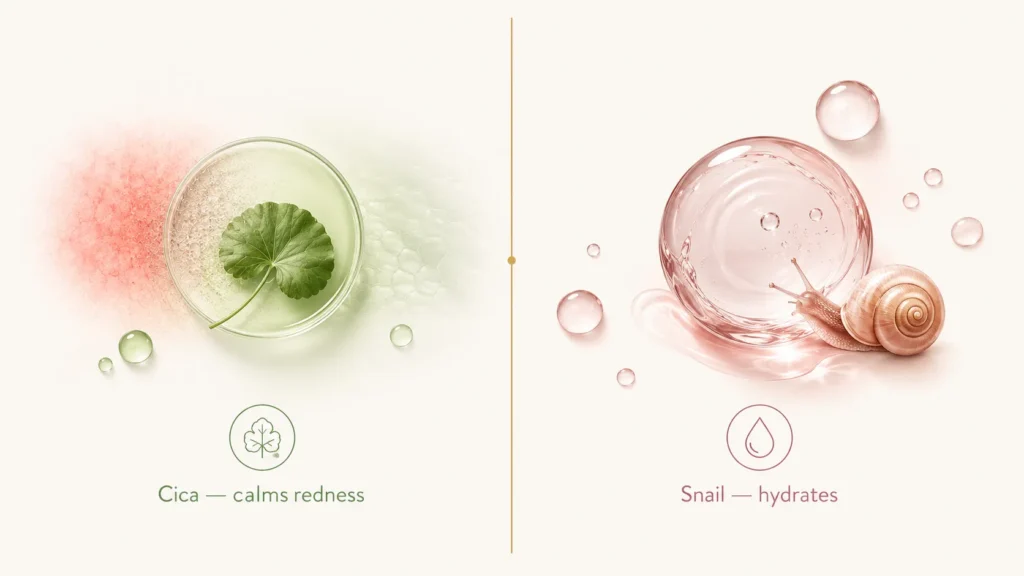
Here’s the summary.
Both are gentle, and both soothe to some degree. But their centers of gravity differ.
Cica specializes in “soothing and barrier repair.” Calming redness, irritation, and reactive skin is its forte. It’s strong for easily flushed skin or skin worn down by actives.
Snail mucin specializes in “hydration.” Replenishing moisture to keep skin plump and resilient is its forte. It’s strong for dry or moisture-depleted skin.
So if redness and sensitivity are your concern, lean cica; if dryness and lack of moisture are your concern, lean snail mucin. Not better or worse — different focuses.
Side by side
| Cica | Snail Mucin | |
|---|---|---|
| Source | Centella asiatica (plant) | Snail secretion |
| Main focus | Soothing + barrier repair | Hydration + soothing |
| Strength | Calming redness and irritation | Delivering moisture |
| Key components | Madecassoside and more | Glycoproteins, hyaluronic acid |
| Common texture | Cream, soothing balm | Essence, cream |
| Best for | Red, sensitive, reactive skin | Dry, moisture-depleted skin |
| Using together | Works | Works |
So which should you choose?
Let’s break it down by goal.
If redness and irritation come first. For easily flushed, reactive skin, or skin worn down by actives, cica takes care of soothing and barrier repair.
If dryness and moisture come first. For tight, parched skin, snail mucin replenishes hydration.
If you want both. You can use them together. Both are gentle, so layering works. Following the “thinnest first” rule, you might replenish moisture with a snail essence and add soothing with cica. It’s an especially good combination for the mixed concern of skin that’s both red and dry.
Wondering about the order to layer ingredients? → How to Use Snail Mucin: The Right Order & Routine (2026)
Frequently asked questions
Cica or snail mucin — which is better? It’s a difference in focus, not a ranking. For redness and soothing, cica; for hydration, snail mucin.
Can I use them together? Yes, both are gentle, so you can. Apply the thinner texture first. It’s an especially good pairing for skin that’s both red and dry.
What about redness or rosacea? Cica has an edge on calming redness. But rosacea is a skin condition, so if symptoms are significant, consult a dermatologist.
What about dry skin? Snail mucin has an edge on hydration. Paired with cica, you can cover both soothing and moisture.
Which do I apply first? The rule is thinnest first. Usually an essence or serum before a heavier cream.
The bottom line
Cica vs snail mucin isn’t about which is better — it’s about focus. Cica is strong at calming redness and irritation and repairing the barrier; snail mucin is strong at replenishing moisture. Both are gentle, so you don’t have to pick just one — you can use them together. Choose based on what’s troubling your skin right now: redness, or dryness.