If you’ve spotted the long name “madecassoside” on an ingredients list, that can be a good sign. Why?
Lately this ingredient gets searched for on its own, apart from cica (centella). That’s because among centella’s many compounds, it’s often called the real star.
The short answer
First, to clear it up: madecassoside is an active compound purified from Centella asiatica. It’s known for being especially good at calming red, irritated skin. But here’s where a lot of people get confused: “So is it the same as cica?” Let’s sort that out.
How centella and madecassoside relate
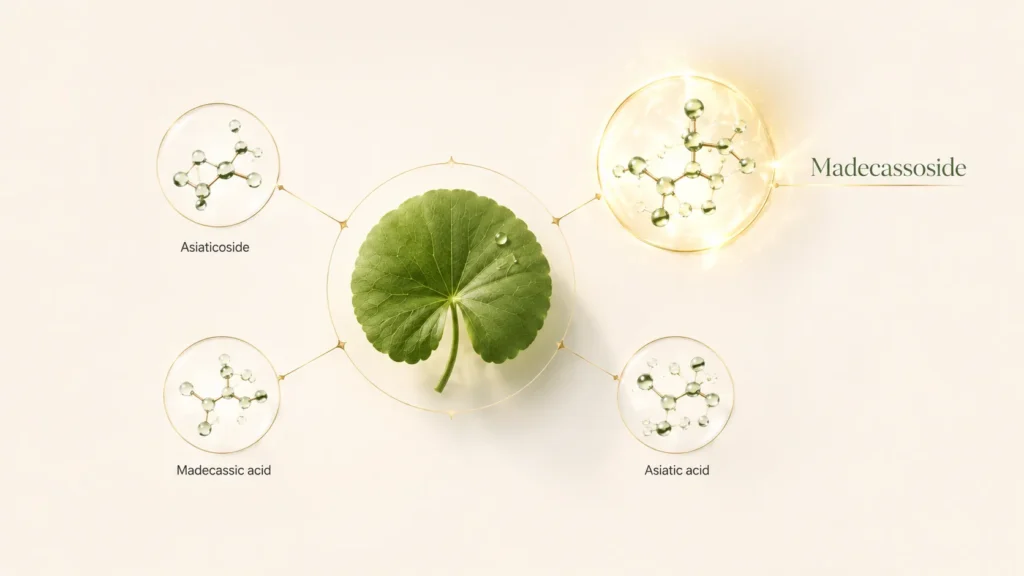
Cica (Centella asiatica) refers to the whole plant. And inside that plant are several active compounds — four main ones: madecassoside, asiaticoside, madecassic acid, and asiatic acid.
So madecassoside is one compound within the bigger picture of centella. If centella is an orchestra, madecassoside is its most prominent soloist — standing out especially at calming redness and irritation.
For context, these four split by structure too. Madecassoside and asiaticoside are the sugar-attached forms (saponins), while madecassic acid and asiatic acid are the sugar-free forms. The names are similar and easy to mix up, so it’s worth knowing.
Why it’s special: calming redness
Madecassoside gets attention because it’s strong at calming redness and irritation.
As cosmetic chemists point out, countless plant extracts claim to be “soothing,” but few actually have clinical evidence behind them. Centella is among those with real data — and the main players behind that soothing effect are madecassoside and asiaticoside.
For example, for easily flushed skin such as rosacea-prone skin, purified madecassoside has been reported in research to visibly reduce redness over several weeks. Madecassoside is also water-soluble, so it’s known to absorb into skin relatively well.
That said, results like these depend heavily on a product’s concentration and formulation, and they vary from person to person.
The key: plain centella vs madecassoside products
Here’s the part that matters most in practice.
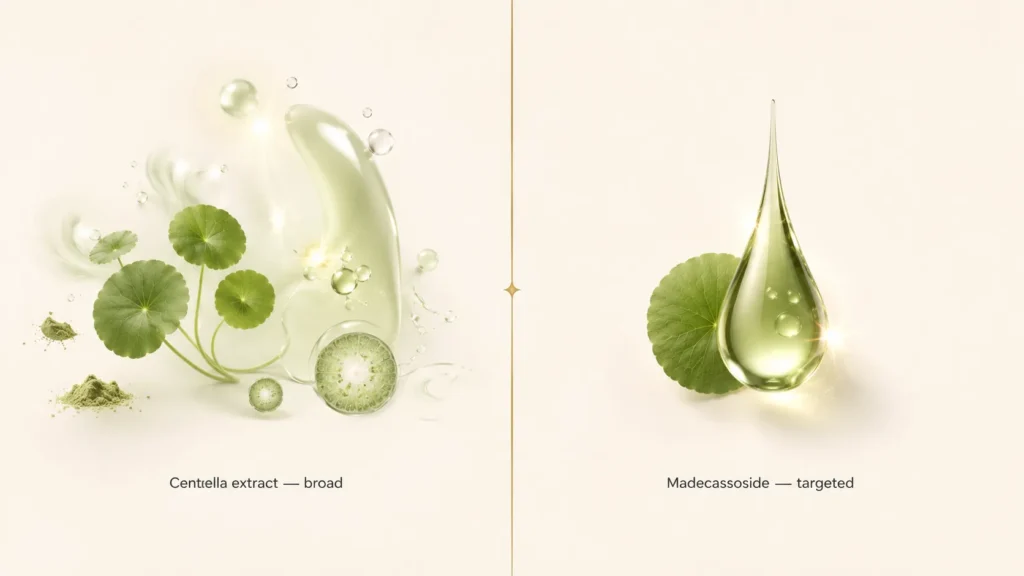
A product listing only “Centella Asiatica Extract” or “cica” usually contains those four compounds blended naturally. A product that specifically names “madecassoside,” on the other hand, likely uses a more isolated, concentrated form of it.
So which is better? It’s genuinely not about crowning a winner.
A product that names madecassoside is strong at calming redness quickly and in a targeted way. A product with the full centella extract has several compounds working together, making it strong for barrier strengthening and longer-term recovery. Different roles.
In short: if you want to quickly calm sudden redness or irritation, a product that names madecassoside fits; if you want overall soothing and barrier care, a centella extract product fits. That’s exactly why many brands include both.
What it does, and who it’s for
Madecassoside is known to suit these skin types especially:
Easily flushed or reactive skin, the lingering redness left after acne marks, and skin worn down by actives like retinol or acids.
Here’s a tip for using it: when you’re on an active like retinol or an acid, layering a madecassoside product as a calming layer can help your skin take that active more comfortably.
Curious about combinations that help you tolerate actives? → PDRN vs Retinol: Which Should You Use? (2026)
Want the big picture on cica? → What Is Cica Skincare? Centella Asiatica Explained (2026)
Madecassoside is also known to pair comfortably with ingredients like vitamin C, hyaluronic acid, and glycerin.
How to read the label
A few things to look for when spotting madecassoside on an ingredients list.
If it says “Madecassoside,” a purified form is being used. If it only says “Centella Asiatica Extract,” it’s the four-compound blend. If both appear, it may be an extract base boosted with added madecassoside.
Don’t confuse it with the similarly named madecassic acid or asiaticoside — those are different compounds.
And if calming redness is your goal, a product where madecassoside sits reasonably high on the list — rather than only at the very end — may have an advantage in terms of amount.
Frequently asked questions
Are madecassoside and centella different? Centella refers to the whole plant; madecassoside is one compound purified from it. Madecassoside is especially strong at calming redness.
Is madecassoside better than centella? It’s not about a winner. Madecassoside is strong for quick, targeted calming; the full centella extract is strong for barrier strengthening and longer-term recovery. Different roles.
What does madecassoside do? It’s known for being strong at calming redness and irritation. It suits easily flushed or reactive skin.
Is it safe for sensitive skin? It’s known to be gentle. But it depends on a product’s concentration and formulation, and results vary — so patch-test any new product first. If you have a condition like rosacea, consult a dermatologist.
How do I spot it on a label? If “Madecassoside” is named, it’s a purified form; if only “Centella Asiatica Extract” appears, it’s the four-compound blend.
Can I use it with other ingredients? It’s known to pair comfortably with vitamin C, hyaluronic acid, glycerin, and more.
The bottom line
Madecassoside is the “star” compound inside the centella plant that handles calming redness. A plain centella product and one that names madecassoside play slightly different roles. For quick, targeted calming reach for madecassoside; for overall recovery, centella extract — and in many cases, both together. Now, when you meet that long name on an ingredients list, you’ll know what it means.