Skincare made from salmon DNA. A few years ago it would have sounded like a strange experiment, but in 2026 it sits at the center of K-beauty. Vogue and other outlets named PDRN a dominant ingredient of the year, and on TikTok it spread as “the glass-skin secret.”
This guide covers everything you need to know about PDRN: what it is, why it’s trending, what the science says, and — most importantly — the injectable-vs-topical difference most people miss. Get the big picture here, then follow the links to go deeper.
What is PDRN?
PDRN stands for polydeoxyribonucleotide — fragments of DNA sourced from salmon or trout. Because salmon DNA is close to human DNA at the molecular level, once purified it’s known to be highly biocompatible and low-risk. It’s drawing attention as an ingredient that supports skin repair and recovery.
Despite the attention-grabbing “salmon DNA” name, the science behind it is more ordinary than the headline suggests.
More on what it is and the evidence → What Is PDRN Skincare? The Salmon DNA Trend Explained (2026)
Why is it trending?
What makes PDRN interesting is that it didn’t start as marketing — it started in clinics. Korean dermatology used PDRN injections for wound healing and repair for years, and as it moved into topical serums and creams, it went mainstream.
The big shift in skincare for 2026 is the move from “anti-aging” to “skin repair and longevity” — and PDRN became its poster ingredient.
The benefits: what the science says
Let’s separate the established from the uncertain.
The injectable has fairly strong evidence for elasticity, fine lines, and wound healing.
Topical products focus on barrier recovery and hydration, with improvements often reported over 8–12 weeks of consistent use.
That said, claims of dramatically erasing wrinkles aren’t sufficiently proven. PDRN is best seen as an evidence-backed recovery and hydration ingredient.
The studies and evidence in detail → What Is PDRN Skincare? The Salmon DNA Trend Explained (2026)
The most important thing: injectable vs topical
This is the most important distinction in understanding PDRN — and the part most content blurs.
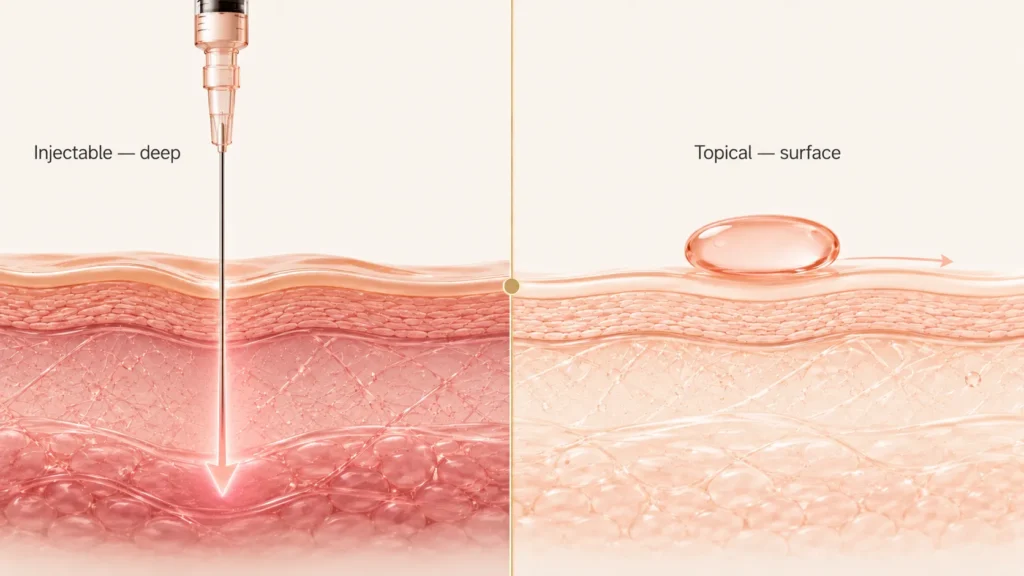
The injectable is delivered into the dermis with a needle, bypassing the surface barrier to reach deeper layers. This is what made PDRN famous in the first place.
Topical products have very large molecules (50,000–1,500,000 daltons), so the skin barrier — which doesn’t readily let molecules over 500 daltons through — keeps them mostly acting on the surface.
So injections aim for deep renewal, while topical products realistically offer surface hydration and recovery. The claim that a topical matches an injectable hasn’t been established.
For context, PN injectable treatments generally can’t be legally obtained in the US, while PDRN cosmetics are available for cosmetic use only.
How it compares to other ingredients
PDRN is often compared with two ingredients.
Snail mucin — a gentle daily ingredient centered on hydration and soothing. Where PDRN focuses on regeneration and recovery, snail mucin is closer to everyday moisture and calm. Different goals, and you can use them together.
Read more → PDRN vs Snail Mucin: Which Should You Use? (2026)
Retinol — the gold standard of anti-aging. Where retinol actively drives cell turnover, PDRN helps the skin recover. Their approaches are opposite, so they have synergy when used together — with PDRN applied first.
Read more → PDRN vs Retinol: Which Should You Use? (2026)
How to use it
Topical PDRN is used like any serum. Apply it at the moisturizing stage after cleansing and toner, and in the morning layer sunscreen over it.
On an ingredients list, look for Sodium DNA, Polydeoxyribonucleotide, or Sodium Polydeoxyribonucleotide — all the same ingredient.
If you’re using it with an active like retinol, apply PDRN first and let it fully absorb before layering the active on top. Patch-test any new product on your inner arm first.
Choosing a sunscreen to finish your morning routine → Best Korean Sunscreen 2026: The Complete Guide
Choosing a formula
PDRN products feel different by format.
Serum — the most common format. Absorbs lightly, and is often blended with other ingredients.
Cream — richer hydration, suited to dry or compromised skin.
Ampoule — a concentrated format for intensive care.
When choosing, check where PDRN (or Sodium DNA) sits on the ingredients list, what else is in the formula (hydrating or soothing ingredients), and whether the texture suits your skin type.
The formats above are examples; individual results vary.
Frequently asked questions
Does PDRN really work? The injectable form has fairly strong evidence for elasticity, fine lines, and more. Topical products offer surface hydration and recovery; matching injectable results isn’t established. It’s a gentle, well-tolerated ingredient, but not a “miracle in a bottle.”
Is putting salmon DNA on your skin safe? Salmon DNA is close to human DNA, making it highly biocompatible, and once purified it’s known to be low-risk. Results vary, so a patch test is recommended.
Does a topical work as well as an injectable? Not established. The molecule is large, so topicals mostly act on the surface. For deep renewal, a procedure is a different option — one to discuss with a dermatologist.
When do I apply it? At the moisturizing stage after cleansing and toner. In the morning, layer sunscreen over it.
How does it differ from snail mucin and retinol? Snail mucin focuses on hydration and soothing, retinol on cell turnover, and PDRN on recovery. See the comparison links above for the full breakdown.
How do I spot PDRN on an ingredients list? It’s listed as Sodium DNA, Polydeoxyribonucleotide, or Sodium Polydeoxyribonucleotide — all the same ingredient.
The bottom line
Despite the unfamiliar “salmon DNA” name, PDRN is an evidence-backed ingredient that started in the clinic. The key thing to remember is that injectable and topical are not the same. Injections aim for deep renewal; topical products realistically offer surface hydration and recovery. Understand that distinction, and you can make smart use of PDRN without inflated expectations. Each topic is covered in more depth in the detailed guides above.